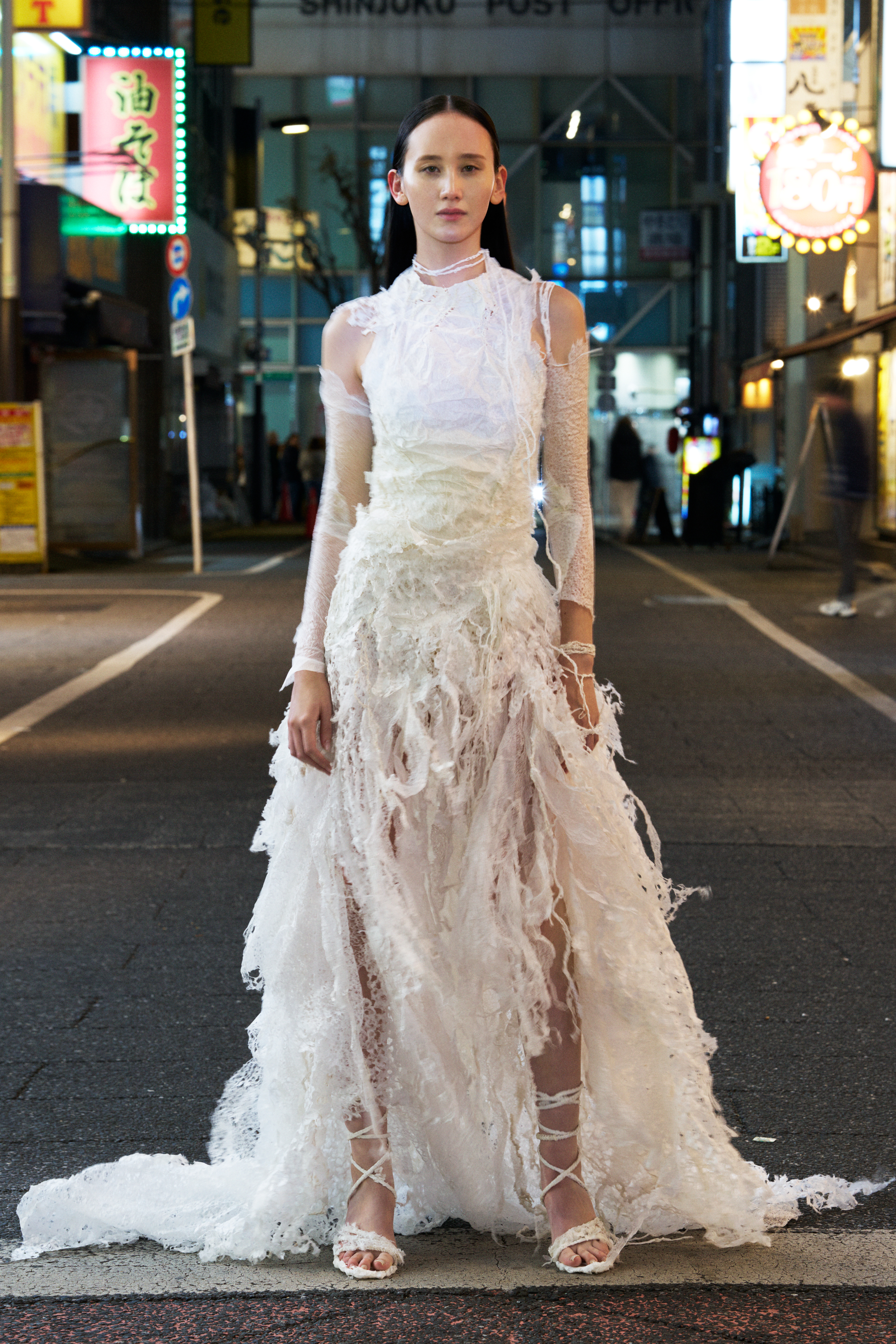
Echizen washi quietly shifts its form over time.
When touched, it softens and grows fragile; immersed in water, it dissolves back into fibers and can be pulled into life once again.
This transformation is not a flaw but a subtle trace of the time the material has held.
I grew up in Fukui, surrounded by washi from an early age.
I remember returning torn paper to water and reshaping it into something new—
a childhood experience that quietly engraved in me the sense of “returning, changing, and being born again.”
Washi does not disappear when it breaks; it simply changes its state and continues to exist.
That way of being resonates with the bodily consciousness I cultivated through rhythmic gymnastics and ballet—
the feeling of the boundary between body and clothing loosening.
As the body moves, the garment sways, and that sway, in turn, reflects the body back to itself.
Washi receives these minute shifts and holds them as quiet layers.
As my practice deepened, I learned that Echizen is a place where Kawakami Gozen—
the deity said to have brought paper into the world—is enshrined,
and where papermaking has continued for over a thousand years, constantly adapting in form.
Its continuity is, to me, an accumulation of time carried forward through the act of making.
“SUKU” does not deny breaking;
it is a garment that embraces transformation as it is.
Rather than fixing a single point of completion, it continues to change with the wearer’s time,
and those changes become memories that belong only to that person.
I wish to present clothing as something that is handed over, carried on,
and lives together with the passage of time.
Like washi itself, garments, too, are things that continue.
Material: Echizen Washi, konjac glue
Supported by: RYOZO paper mill
Photography by YASUNARI KIKUMA / ©︎ FASHION FRONTIER PROGRAM
Instagram:@not________find