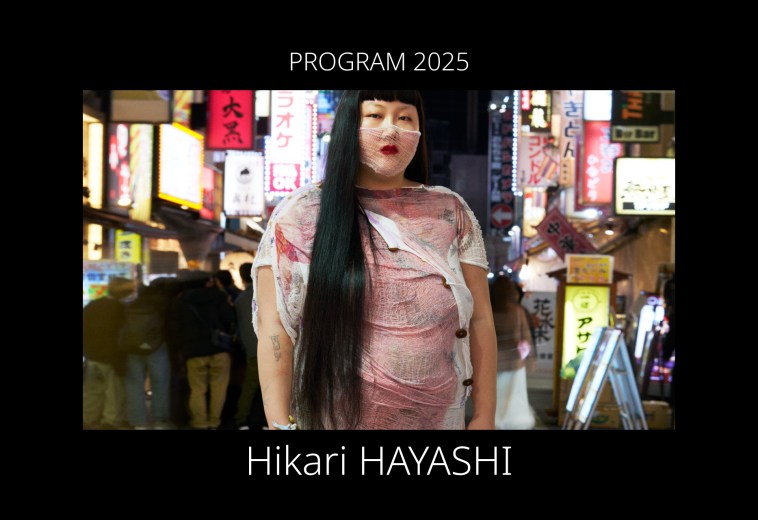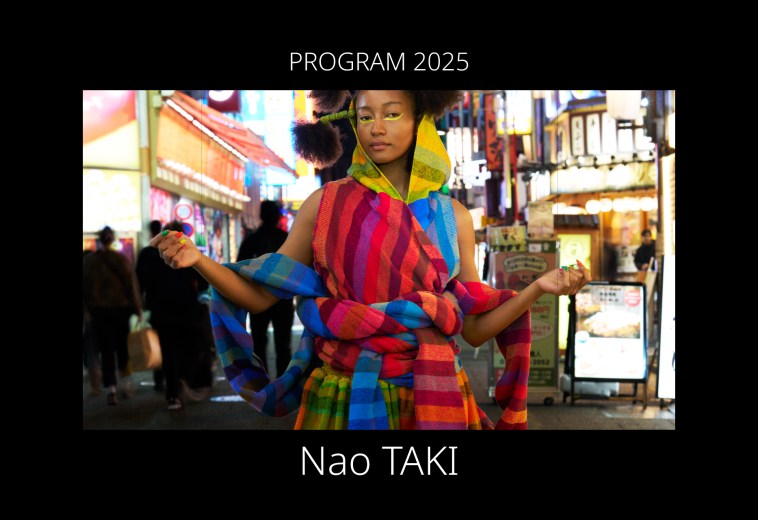
By virtually exhibiting designs with a wide variety of patterns using chroma key technology, we minimize sample quantities and engineer to reduce waste throughout the manufacturing process as much as possible. We then produce appropriate quantities by leveraging printing technologies such as digital textile printing and large-format printing.
This approach aims to reduce overall waste by minimizing the number of clothing samples, decreasing fabric waste during production, and reducing inventory through made-to-order systems.
Material: Cotton, Polyester
Photography by YASUNARI KIKUMA / ©︎ FASHION FRONTIER PROGRAM

Like fashion, the production activities that support graphic design have long been embedded in a mass production and mass consumption structure. In the coming age, the question is how to use limited resources.
In this work, flyers and other materials that have lost their role after the exhibition has ended are pasted together, laminated and crystallized, and combined with surplus threads and strings from production to make clothing.
The accent beads are defined as “socially artificial minerals” produced by people’s economic activities, and the work proposes new possibilities for paper as a “material” rather than a “medium” for its role.
In this work, flyers and other materials that have lost their role after the exhibition has ended are pasted together, laminated and crystallized, and combined with surplus threads and strings from production to make clothing.
The accent beads are defined as “socially artificial minerals” produced by people’s economic activities, and the work proposes new possibilities for paper as a “material” rather than a “medium” for its role.
Material: Surplus leaflets, surplus paper, surplus yarn, surplus string
Hair and Makeup by Nozomi Onda for SHISEIDO
Photography by YASUNARI KIKUMA / ©︎ FASHION FRONTIER PROGRAM
Yuriko Wada
E-mail: info@paperparade.tokyo