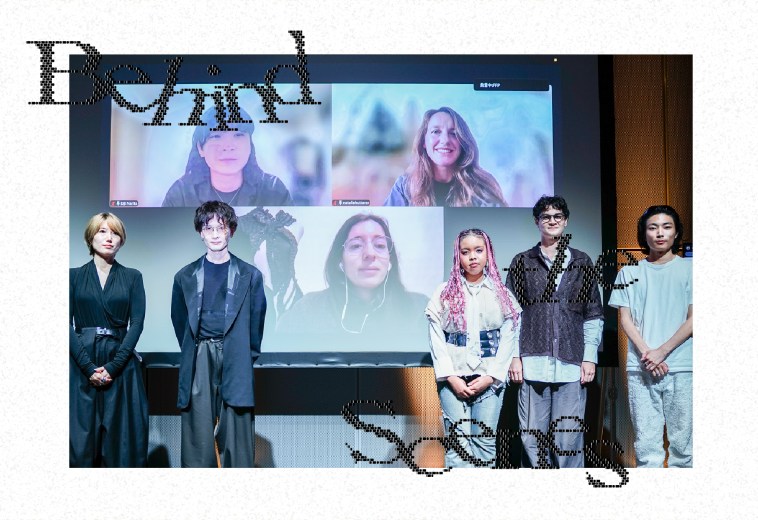
The FASHION FRONTIER PROGRAM (FFP) is dedicated to nurturing designers who embody both social responsibility and creativity in their clothing designs. In the second roundtable discussion for this program, Nobuko Nakano, a neuroscientist well-versed in art and fashion, Hiroaki Miyata, a scholar in data science and scientific methodology with a keen interest in fashion, and Yuima Nakazato, the initiator of FFP and a fashion designer, came together to discuss diversity and inclusion.
Nobuko Nakano(neuroscientist): In essence, I believe diversity is a survival strategy aimed at species preservation. Consider the bananas we eat today: they are clones and are not grown from seeds. Because of this, you often hear stories about how a single virus or pathogen can put an entire region’s banana population at risk of extinction. Then there are jellyfish, which reproduce both asexually and sexually during their lifecycle. This approach leverages the efficiency of asexual reproduction, which allows for rapid proliferation, as well as the adaptability of sexual reproduction, making them more resilient to environmental changes. However, we humans have opted for sexual reproduction. Despite the high costs, which include having to seek out a partner and the intense physical toll on women during childbirth, we continue this method. This suggests that we’ve chosen a survival strategy that offers benefits unattainable through asexual reproduction. Perhaps it’s this very advantage, chosen even at great costs, that underscores the significance of diversity.
Hiroaki Miyata(Professor and Chair, Department of Health Policy Management, Faculty of Medicine, Keio University): Considering factors like climate change, the presence of diversity certainly increases the chances of human survival. So, one could argue that ‘diversity is essential for survival strategy’. For instance, when discussing ‘environment and sustainability,’ many Japanese people believe that ‘nature, in its unaltered state, is best.’ Yet, in places like deserts, leaving things as they are could lead to human demise. There’s value in perspectives that see ‘artificially blooming flowers across a vast landscape’ as a good thing. Acknowledging diverse viewpoints is crucial.
However, if we solely define diversity as ‘essential for a survival strategy,’ there could be scenarios where retaining just one highly adaptive species might be the best approach. Locally, there might be situations where ‘focusing intensely on one point and forgoing diversity is the better choice,’ which could seemingly negate the importance of diversity. So, I’d like to emphasize the necessity of diversity from angles other than just biological survival strategies.
Throughout history, we have always pondered the question, “What kind of society should we create?” In the 20th century, John Rawls argued, to put it simply, that we should aim to build a society where anyone, regardless of their circumstances, can affirm their existence. Whether they are born into poverty, belong to a minority group, or are born with innate disabilities, Rawls advocated for creating a societal framework in which they can find affirmation. His propositions were criticized during his time, with many dismissing them as idealistic or even impossible, stating, “It’s unfeasible to consider every perspective.” As a result, even Rawls himself retracted some of his own thoughts in his later years. However, with the advent of digital technology, we can now connect and empathize with various perspectives more than ever. Take the conflict between Ukraine and Russia, for instance. Not so long ago, such a conflict might have been dismissed as a regional dispute. But now, smaller nations worldwide watch the situation in Ukraine, fearing, “We could be next,” and criticize by saying, “If we accept Russia’s actions, we are permitting a world where nuclear-armed superpowers can invade freely.” Now that we have access to diverse perspectives through digital technology, we need diversity more than ever in order to realize our ideal world.
Nakazato: Last year, Prof. Miyata and I engaged in a dialogue on the same theme of “Diversity and Inclusion.” However, this year, I was thinking that perhaps it would be apt to also introduce “Fairness” into the discussion. The points raised by Prof. Miyata seem to be intrinsically linked to fairness. Essentially, due to the rise of digital advancements, we find ourselves in an environment where we can empathize with a broad spectrum of people and situations. So, I’m pondering if this might be the reason why the topic of diversity is gaining such traction in societal discussions nowadays. Dr. Nakano, how do you perceive this matter?
NAKANO: Well, I might also think that we’ve reached a point where we must specifically discuss diversity. I’m in my 40s now, and when I was a child, every time I rode the train, there would always be two or three individuals who today would be labeled as having mental disorders. In our childhood communities, it was not rare to see kids who today would be described as having intellectual disabilities. We had never once thought of excluding these individuals. We had never felt a need for everyone to be the same; in fact, we wanted to stand out. But now, the narrative has shifted significantly. Even when I’m judging literary awards, a large portion of the submitted novels revolve around toxic parenting. With the rise of the internet and social media, information spreads rapidly, leading to increasingly homogenized values. People have become more likely to imitate what’s familiar, and advancements in cosmetic surgery have even led to the emergence of a “trendy face.” Individual happiness is becoming standardized. Even though one might find joy in unique pursuits, there seems to be a societal pressure to align oneself with a communal “standard of happiness.” Perhaps this is why we find ourselves in an era where we need to emphasize and discuss diversity so deliberately.
Nakazato: Then, you mean, within a certain network, a single set of values or aesthetic ideals quickly becomes widespread, and people feel a pressure to conform to it, right? When one is immersed within such a network, it seems challenging to break free. I wonder, how can we overcome this situation?
NAKANO: Neuroscience suggests that the brain areas responsible for personal preferences, for discerning trends based on others’ reactions, and for processing something as ‘cool’ even if not necessarily beautiful, are all distinct from one another. When we make choices, these mechanisms interplay in intricate ways. Consider the Pepsi Challenge: when participants tasted unlabeled Pepsi and Coca-Cola, a slim majority preferred Pepsi. Yet, when labels were attached, more leaned towards Coca-Cola. This experiment highlights that often, influenced by others’ reactions, people might opt for something diverging from their intrinsic tastes. In marketing, this phenomenon is leveraged. Think about how celebrity endorsements influence fashion choices or how a product’s perceived coolness can drive its popularity. While these types of brain reactions are crucial, one’s genuine ‘taste’ is rooted elsewhere. It’s essential not to suppress that authentic preference of each person. At the same time, we must not stifle the tastes of those around us. Perhaps this is the essence of ‘inclusion’. Regardless of how out-of-trend a preference might be, it holds significance. To break free from the pressures of network-enforced aesthetics and values, I believe one needs to respect and protect both their own and others’ tastes. Those who can do this are best poised to carve out their unique world.
NAKAZATO: “One needs to respect and protect both their own and others’ taste.” That’s crucial, indeed. Prof. Miyata, what are your thoughts on the reason diversity is currently such a hot topic in society?
Miyata: The discourse around diversity isn’t a recent advent. The term “multiculturalism” has been in our lexicon for some time now. However, the rise of the internet, which has made us privy to a myriad of perspectives, has been a game-changer. Earlier, I mentioned that “In this digital age, where we can inhabit diverse stances, diversity is imperative for creating an ideal world.” Yet, merely connecting information doesn’t automatically steer people, communities, or societies toward a better direction. It’s not that simple. There are various factors at play. For instance, the language barrier is significant. Within a shared language community, there’s a heightened pressure to conform, leading to situations like the one Dr. Nakano described, where even facial features start to homogenize.
Another significant factor is the monetary motivation behind our interconnectedness via the internet. Think of Facebook, Google, Amazon — the linchpin of the digital business empire rests upon keeping users engaged within their services for as long as possible. The aim? Immerse users in a comforting experience, which invariably prompts them to spend. As a result, any discomfort is filtered out. Thus, people cluster with those sharing a similar sense of “comfort.” Although this “comfort” is diverse in itself, there’s no bridge between these silos, leading to an agonizingly fractured scenario.
Remember the genesis of “Black Lives Matter” in the U.S., stemming from the brutalities faced by African Americans at the hands of Police? Come 2020, there was significant debate over its appropriate translation into Japanese. Some mistranslated it as signifying “Every human being is significant.” But America has long heralded its tenets of anti-discrimination, cherishing freedom and diversity, celebrating its ‘melting pot’ of multiculturalism. Yet, underneath this narrative, disparities have continually widened. Even with the abolition of slavery and the championing of Black rights, disparities rooted in environment, education, and more, grew to an extent that couldn’t be ignored. Hence, the essence of BLM emerges: it’s not merely a utopian “every life is valuable” slogan. It underscores the urgency to address those glaringly oppressed first. BLM means, without this recognition and societal introspection, progress becomes an elusive dream.
The ethos of BLM isn’t something Japan can regard as irrelevant. At the Expo 2020 Dubai held in the United Arab Emirates (UAE), women played pivotal roles. This was an intentional move, aiming to inspire change and challenge the gender inequality prevalent in its neighboring countries. Take, for instance, Saudi Arabia, right next to Dubai — it was only a few years ago that they used an outrageous reasoning that women were “intellectually inferior” to bar them from driving. Gender disparity is a crucial aspect when considering diversity. However, as of 2022, the UAE ranks 68th in global gender gap indices, while Saudi Arabia sits at 128th, and Japan? It’s at 121st, alarmingly close to Saudi Arabia. The sheer lack of awareness of this issue within Japan is a problem in itself. What this underscores is that the conversation around “diversity” is not just about maintaining a friendly coexistence; it’s much deeper and more pressing than that.

NAKANO:More often than not, rather than being consciously aware of hurting or discriminating against someone, I tend to approach conversations under the assumption that the other person might hold biases against me. Some men are bound by this almost curse-like belief that they must be stronger than women. Accidentally doing something that might injure such a man’s pride can lead to his anger. Even when a woman achieves something through hard work, there are instances where people think, ‘There’s no way a woman can possess such skills; she must have a man backing her up.’ It’s disheartening. One strategy to navigate such scenarios might be to avoid overly emphasizing one’s achievements. Some women might adopt a tactic of showcasing that they’re managing things all by themselves. Others genuinely find male figures who act as their support. I believe each person has their unique way of handling it. As for me, I tend to exert moderation, ensuring I try not to give my absolute all.
Nakazato: Isn’t that quite a waste?
Nakano: Do you think so? I believe that giving one’s all isn’t necessarily always the best approach. And not just in this context — judging the merits of something is, in fact, quite challenging. Even if you act with the best intentions, it’s not always clear whether it was truly the right thing to do. It might even be meddling where it’s not wanted… I often reflect on the fact that well-intentioned actions don’t always equate to the best outcomes.
Miyata: I wholeheartedly agree that it’s crucial to be self-aware and recognize that actions taken with good intentions might not always be right. We often hear misguided executives from big corporations say things like, ‘Women don’t want promotions. I’ve asked them, I know.’ However, before making such claims, they should question whether they’ve truly created an environment where women can genuinely and openly express their desires. For instance, in Japan, when it comes to life decisions such as choosing between childbirth and career, most women feel pressured to pick only one, mainly due to societal constraints. Despite this, it’s a grave mistake for men to hastily conclude without understanding the circumstances, ‘She didn’t want it.’ Including unconscious biases, making neutral choices is tough.
This example pertains to gender disparities, but the same could be said about nature. Many Japanese believe that nature should be left as it is. Yet, for people in colder regions like Scandinavia, nature isn’t just a blessing; it’s a force that can swiftly take one’s life if they’re not careful. What one culture or region believes to be good might not resonate the same way in another. In this era that emphasizes diversity, the roles of art, design, and expression are evolving. As exemplified by Marcel Duchamp’s works, the focus used to be on breaking established norms. But perhaps, going forward, the emphasis will be on ‘creating something that can be shared.
Then, what can be considered ‘something that can be shared’? In a past conversation with the director of the Mori Art Museum, Ms. Mami Kataoka, she mentioned that ‘prayers’ and ‘anxieties’ are sentiments shared across many people. Ms. Kataoka was the artistic director of the ‘Aichi Triennale 2022’ in Japan, she mentioned that merely saying ‘we value our region’ doesn’t help in connecting with other regions. So, she delved deep into the history of the region, fervently searching for its inherent prayers and anxieties about the future. Basing her approach on these findings, she noted that it enabled her to form new connections with various people and places. In the past, ‘prayers’ and ‘anxieties’ were top-down, usually presented by religious leaders to their followers. However, perhaps in the future, it’ll be a bottom-up approach where common prayers and concerns about the future serve as the glue that binds society together.

Nakano: Uniforms have often been cited as measures against poverty, and I know they serve a specific role. However, it’s said that the very foundation of school education stems from the idea of universal conscription. If you ponder why “compulsory education” is termed “compulsory,” it is because it’s a duty to the state. There was once a paradigm where the goal was to nurture “standard products,” meaning soldiers. The premise is that citizens have an obligation to raise such individuals. Setting uniform clothing in such environments, regardless of its merits or demerits, feels to me like it can lead to standardised education and consequently, standardised thinking.
There’s a fascinating study where, upon investigating the genes of body lice that infest clothing, it appears they diverged from their original species about 70,000 years ago. Thus, the history of clothing is believed to have started around that time. Another intriguing research suggests that, when looking at the divergence of critical genes governing language, it seems humans might have begun using spoken language approximately 70,000 years ago – a theory that’s gaining traction. Considering these two facts, it appears that the inception of language and the advent of clothing happened almost concurrently. Both, undeniably, are vital tools of communication.
Nakazato: I see. You mean, while clothing serves as a vital communication tool, uniforms essentially standardize that communication. Prof. Miyata, I’ve noticed through various media appearances that you have a diverse sense of style. What are your thoughts on uniforms?
Miyata: When I participate in projects that envision the future, I wear clothing as a means to introduce an element of “discomfort” or “feeling odd” amongst my collaborators. Suits, much like uniforms, serve as a tool for living as a cog in the machine, as Dr. Nakano mentioned. This is different from the message I want to convey through clothing.
Let’s briefly travel back in history. Dr. Nakano mentioned that both language and clothing originated around 70,000 years ago. Subsequently, in the great ancient civilizations, large-scale water management projects became prevalent. Such grand endeavors required rallying the masses. Rulers utilized the authority of gods or the majesty of kings to unify the populace. Fashion played a pivotal role in visibly establishing this authority. For instance, while commoners or slaves went barefoot, kings might wear distinctive sandals, or adornments were used to signify social standing. As time went on and societies shifted from authority-driven to wealth-driven, fashion continued to serve as an emblem of wealth. With the onset of the Industrial Revolution and the emergence of mass production and consumption, there arose a need for individuals to act as cogs in this machine. In a sense, uniforms and suits appeared as mental constraints.
This might sound overly optimistic, but I believe this status quo will change. As mass production and consumption cease to be the primary business models, society will no longer be solely driven by economics but by a vision of “how the world ought to be.” This shift will give birth to diverse cultures that will drive the economy. Until now, if one tried to steer the future based on a vision, they’d be told, “That won’t make money,” or “What you’re doing is pointless.” But moving forward, the world will be driven by diverse visions and hopes. In an era where homogenized strategies no longer secure victories, even those who were economy-driven will need to pivot towards diversity-driven initiatives.
What we must reiterate here is that the fashion industry, until now, was based on economy driven that assumed mass production and consumption. The industry created trends by dictating, “This is stylish to own,” and “If you deviate from this, you’re out of touch.” They purposely changed these trends quickly, leading to statements like, “Wearing that now is out of date,” pushing for disposal. This cycle, with events like Paris Fashion Week at its apex, drove the fashion market. Now, a significant reflection on such wasteful practices and attitudes is propelling the fashion industry towards a significant sustainability pivot.
The era of mass consumption and production is coming to an end. Instead of viewing people as expendable or standard products, the focus will shift to enriching people’s lives. Since fashion is a communication tool that connects society and individuals, it becomes crucial in this new era to determine how fashion will connect and inspire people.
Nakazato: Indeed, as you pointed out, the fashion industry has always been unilaterally insisting on what is currently stylish and changed that narrative every six months. While economically efficient, this approach is now recognized for its environmental consequences, both by producers and consumers alike. Amidst this, the challenge lies in finding a way to sustain the industry while respecting the individuality of each person.

Nakano: That’s an intriguing perspective. Interestingly, we use a considerable portion of our prefrontal cortex for the cognition of beauty and decoration. There’s inherently no need to recognize concepts like “cool,” “beautiful,” or “I want to wear that logo” for combat or major projects. However, having this capability means we can resonate with others without speaking—recognizing shared affinities and indirectly contributing to cooperative strength.
Moving away from the topic of combat, clothing acts as a social token, saying, “Oh, you wear YUIMA NAKAZATO too? I love it.” Even if it might seem unnecessary at a glance, our brains dedicate a significant portion of their processing power to “decoration.” Given the complex social structures in which we live, it’s likely that these elements play a pivotal role.
What’s even more intriguing is the removable nature of clothing. When fighting as a member of the military, one wears the uniform of authority. But in other occasions, one might wear the uniforms of family, comrades, or other professions—or simply dress in what they like. The act of changing clothes lightens the task of navigating the multiple personas of our complex identities. Humans can belong to various groups, and while it may not be widely accepted in modern ethics, some even have multiple families. Primates, in contrast, can’t belong to various groups. Once they leave a group, they’re essentially considered dead to their former peers and are no longer recognized as allies. One speculative reason humans possess such uniquely complex identities might be the parallel evolution of language and clothing.
At least, clothing affects our internal cognition. This influence, in turn, manifests in our behavior. Although not a fashion experiment, there’s a study showing significant differences in salivary testosterone levels when the same individual is seated in a luxury sports car like a Ferrari compared to a common vehicle like a Corolla. Even a person with high secular status, when dressed in a casual, damaged T-shirt, tends to feel more laid-back. While “decollation” might be a broad term, it significantly impacts cognition. The idea that one’s attire can potentially control, or even be controlled by, a collective consciousness is something that fashion creators should be aware of.
Miyata: The idea that humans, unlike primates, can hold multiple personas is absolutely fascinating. Historically, we’ve always prioritized physical communities, allowing ourselves to be swayed by the opinions of those within a certain radius. In that context, we’ve interpreted and disseminated fashion trends originating from places like Paris in a top-down manner. However, with the rise of the internet, we can now connect with people in Barcelona and Copenhagen through a shared love of common interests such as art.
New fashion and cultural trends can now be built and shaped from the bottom up within these kinds of internet-based communities. I believe that fashion can play a major role in this process of “co-creation” and “building connections.” I see potential there.
Furthermore, there’s also the role fashion plays in virtual spaces with avatars. That might even become the primary fashion domain. As a longtime fashion geek, I’ve often been frustrated with the monotony of men’s fashion. While I’ve worn women’s clothes, about 70% of the women’s section is filled with dresses and one-pieces, limiting what I can wear. Enka singer Kiyoshi Hikawa wears more women’s clothing than I do, so maybe I just lack the courage, but I’ve always felt confined. However, avatars free us from body image constraints. By dressing our avatars in diverse fashions, we can create varied connections. Holding multiple personas and connecting with people on multiple layers is what I call “multilayered democracy.” Fashion can do a lot for this “multilayered democracy.” The act of “wearing clothes” is essential to the design of individuals and society. If we reconsider the clothes we’ve been made to wear, like uniforms or suits, and view them as choices, we see vast potential in fashion.
Reflecting on Mr. Nakazato’s initial question about real-world clothing, I believe there’s a significant difference between women’s and men’s fashion. Women’s fashion, with its elaborate decorations, is trend-focused. While it has environmental implications, it also mirrors the world’s beauty. Sei Shonagon’s portrayal of the transient beauty of dawn in “The Pillow Book” remains timeless even after a millennium. Similarly, women’s fashion captures fleeting beauty with a keen sensibility. Men’s fashion, on the other hand, often acts as a mental restraint, lacking variety, but it cultivates a culture of using quality items for a longer time in terms of sustainability. Blending the strengths of both to create the next era of fashion from the ground up would be quite exciting.
Nakazato: The influence of decoration on the brain, and the role of fashion in multilayered democracy.—it’s truly captivating. Both of you have provided essential perspectives on fashion in terms of diversity and inclusivity. Thank you so much for today.