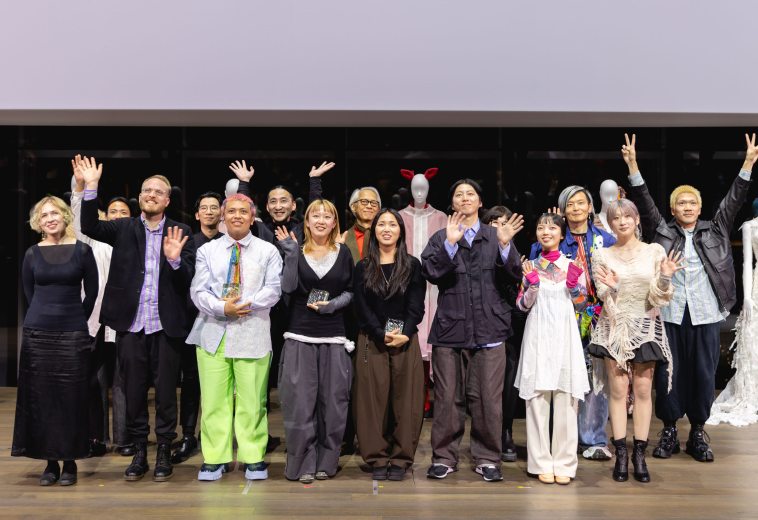
Visit to Epson Corporation
This year’s semi-finalists, two winners from the previous year, and FASHION FRONTIER PROGRAM founder Yuima Nakazato visited the printing facility of Seiko Epson Corporation, a partner company of the FASHION FRONTIER PROGRAM, which supports the program.
In the lecture, the participants learned the difference between pigment and dye printing, analog and digital textile printing, and had an opportunity to see the size of the machines and experience the processes in the facility and feel firsthand the difference in environmental impact.
In addition, some of semi-finalists have done test print.
By observing samples printed on a variety of materials, participants were able to learn how printing is done on different fabrics, the difference in texture between dye and pigment inks, and the difference in processing techniques.


What is Epson’s Printing Facility Solution Center Fujimi?
In addition to conducting research and development of digital textile printing, the center offers test printing using customers’ designs, a clean and compact on-site environment, which is a feature of digital textile printing, and an opportunity to experience the optimal workflow.
In this program, designers’ particular needs for expression are discussed directly with our technicians and print tests are conducted to enhance the degree of perfection of the design.


What they learned and gained from this program
We asked the participants about what they learned and gained from the program.
Most of them said that they learned for the first time that digital textile printing has a low environmental impact, using pigment ink, which reduces water consumption by 96%* compared to analog textile printing using dye ink, and that it can be used in a system that does not generate waste by enabling quick delivery. The participants learned from different perspectives and seemed to be more motivated to explore the possibilities of innovative fashion while being environmentally conscious.
Source: Fuluhashi Environmental Institute, “Report on Direct Water Input in Digital Textile Printing,” February 7, 2022. Report requested by Seiko Epson Corporation.
After the lecture, they learned that the use of pigmented ink, which ‘requires fewer steaming and washing processes, is a good example of a solution to the environmental concerns of analog printing’, which uses large amounts of water, and they learned to think in terms of fewer processes to improve environmental issues. One of semi-finalists also said that one realized that one had often ‘gone back to primitive methods’ when it came to environmental considerations, and that one had made a great discovery that Epson’s technology is ‘both environmentally friendly and innovative.’
Another participant suggested that ‘even in areas where textile printing and other dyeing cultures have not developed due to a lack of water resources, new traditions and industries can be created through the use of digital textile printing.’
Comparing digital textile dyeing and handmade, some participants said that handmade has the advantage of ‘creating a story of the creator,’ while others felt that ‘a story and new value can be created, conveyed, and transmitted’ depending on how designers use digital textile dyeing.
We also asked about ideas that could be utilized in the future.
Ideas for printing on materials already in mind, such as fabrics using leftover threads, ultra-thin organdie, wood, and specially processed blue sheets, were suggested.
Other ideas included layering patterns by applying different prints on the front and back sides using the high positioning accuracy of the machine, applying further dyeing on top of digital textile printing, and combining heat-based processing techniques such as welding and laminating with pigment prints. A wide variety of ideas were gathered.
The online participants also asked detailed questions about the performance and techniques of digital textile printing technology, providing a valuable opportunity to think about how they can utilize the technology to enhance their own works.