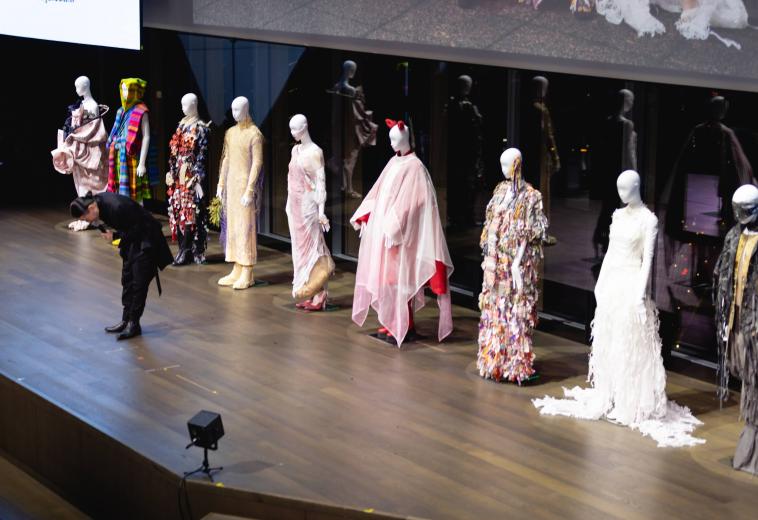
Accompanying videos that trace each finalist’s journey, we present their reflections on the six months of the program and their aspirations as designers moving forward.
These messages embody each individual’s path and resolve—please take a moment to read them.
If you haven’t read Part 1 yet, be sure to check it out.
Hideki Morimoto
Title: OSHIRASAMA
ーーWhat stands out most to you from your experience with FFP?
It was the advice I received from Yuima about how silhouettes relate to the human body. Until then, I had viewed silhouettes as the foundation for expressing design—believing that if there was inspiration or intention drawn from historical context or design sources, that constituted sufficient reason to construct that silhouette. However, this time, as I worked on a design where fabric stood away from the body, I was asked whether that silhouette carried a message strong enough to defy gravity. Rather than creating clothes with design as the starting point, I should consider whether it’s necessary to express the wearer’s emotions. This perspective was entirely new to me, and it made me realize once again that clothing exists because of people.
ーーWhat changes occurred in you before and after participating in FFP?
I am active with the desire to protect Banshu weaving, but I personally felt a gap in the fact that it is the artisans who actually preserve the techniques of Banshu weaving. However, I was impressed by the advice of the expert mentor that traditions will continue naturally by not only trying to preserve them, but also by continuing to create new ways of doing things. I began to think that if I could play a part in creating an environment where new things can continue to be created, I could be contributing to connecting Banshu weaving to the future through my activities.
ーーPlease share your future aspirations for yourself and for society.
Just as many people have the desire to try local food even if it costs a bit more, I hope a similar mindset becomes established for clothing—where people prefer to wear garments made with local materials even at a higher price. To achieve this, I would like to continue activities that communicate the appeal of Japanese materials through clothing, not limited to Banshu-ori alone.
Hikari Hayashi
Title: Reframing
ーーWhat stands out most to you from your experience with FFP?
Participating in FFP fundamentally transformed how I approach making things. Watching the film DUST TO DUST early in the program exposed me to worlds and perspectives I’d never encountered before, and I was struck by the realization that I had been creating without real awareness. It made me recognize that I needed to change my approach, prompting a complete reassessment of my creative practice. Through the learning experiences at FFP, I began engaging not just with the finished work, but with the thinking, choices, and processes that lead to it—updating my fundamental understanding of what it means to make things.
ーーWhat changes occurred in you before and after participating in FFP?
Through the judges’ comments, I realized that in order to move people’s hearts, it’s important that the thing you create itself has emotional power. However, it’s not enough to just have a background and concept; what’s important is how you connect it to the current times, how you interpret it, and how you reconstruct it.
In addition to the lectures, technical advice, and trial and error I experienced through my own creations, interacting with the judges, instructors, and other finalists exposed me to diverse perspectives and ways of thinking, which strengthened my awareness of how my own expression fits into society.
ーーPlease share your future aspirations for yourself and for society.
I want to keep creating new things, but for me, “newness” doesn’t mean inventing something entirely novel. It means shifting how we see what already exists, changing our perspective, and transforming its meaning.
I want to design fashion not just as clothing, but as a “way of being”—encompassing the atmosphere a person carries, their presence, even their memories.
I see this as an important time to broaden the scope of my own work and thinking, and I want to be a designer who continues to renew the possibilities of expression by taking on new challenges without being bound by fields or methods.
Kazusa Horikawa
Title: suku
ーーWhat stands out most to you from your experience with FFP?
What left the deepest impression on me through the creative process was realizing that clothing-making can be much freer. While working with Echizen washi paper, I felt that the act of trial and error itself, rooted in my own physical sensations rather than relying on existing techniques or expertise, could become the creative process. Seeing how each finalist worked in different ways, enjoying the process while moving their hands, made me realize there is no single way to make clothing.
In today’s world where clothes are cheap and easily accessible, discarding them has become just as easy. However, I believe that if more people experience creating through their own bodies, their relationship with objects could change. Additionally, receiving cross-disciplinary feedback from expert mentors and judges broadened my perspective on how to approach and advance my creative work.
ーーWhat changes occurred in you before and after participating in FFP?
Through FFP, I’ve become more able to choose to create while continuing to waver between society’s and my own perspective, rather than coming up with answers that lean towards either one.
Even when it comes to universal questions or discomfort shared by many people, I feel I’ve started to think more about from what position I view the issue and how to present it in form and words, rather than focusing on what is “right” or “easily relatable.”
Even when we all share the same awareness of social issues, the way we start creating and the point at which our hands stop are different for each person.
Through that experience, I’ve become able to accept fluctuations in my perspective and practice as being acceptable to include in my work as they are, rather than treating them as weaknesses, which has been a big change for me.
ーーPlease share your future aspirations for yourself and for society.
In an age where trends and newness are the only things that are consumed with value, I want to continue making clothing that accepts breakage and change as traces of time, rather than as defects.
Furthermore, through my work I quietly share a perspective that allows people to set aside the discomfort and imperfections they may have without denying them, and I would like to present to society the act of clothing as something that gives people space to pause and embodies the individual’s own story.
I would like to continue to question, through something as familiar as clothing, an existence that cannot be reduced to speed or correct answers.
Nao Taki
Title: Wrap me up !
ーーWhat stands out most to you from your experience with FFP?
What left the deepest impression on me through FFP was being able to witness each participant’s creative process and way of thinking. Even though we were all centered around “fashion,” everyone’s starting points, priorities, and approaches to creation were vastly different, and I found that diversity incredibly stimulating.
By learning about other participants’ ideas and their trial-and-error processes, I came to realize that there is no single correct answer in creation, and it gave me an opportunity to reflect on my own creative style from a relative perspective. Being exposed to various processes has been a significant learning experience that has broadened the scope of my own expression.
ーーWhat changes occurred in you before and after participating in FFP?
Before participating in FFP, I primarily approached my work from the perspective of expression and concept, and there were aspects of environmental impact that I hadn’t sufficiently considered. However, through the lectures and dialogues at FFP, I learned about the significant environmental burden the fashion industry places on our planet, and my perspective on creation shifted dramatically. I came to realize that material selection, production methods, and the very attitude toward making are deeply connected to society. Moving forward, I want to be mindful not only of artistic expression but also of environmental considerations in my creative process. I feel this shift in awareness has given me an opportunity to view my work from a broader perspective.
ーーPlease share your future aspirations for yourself and for society.
Moving forward, I want to challenge myself to create with a deeper consideration of how clothing can accompany people in their daily lives and emotions. I aim to develop designs that naturally resonate with the wearer’s body, circumstances, and feelings, while generating a slightly more positive mindset.
My goal is to become a designer who can propose clothing that functions continuously in actual life, while maintaining strength as a form of expression.
FOLLOW US
●○━━━━━━━━━━━━━━○●
Please follow FASHION FRONTIER PROGRAM on Instagram for the latest information.
▶︎▶︎FFPInstagram https://www.instagram.com/ffp.jp/