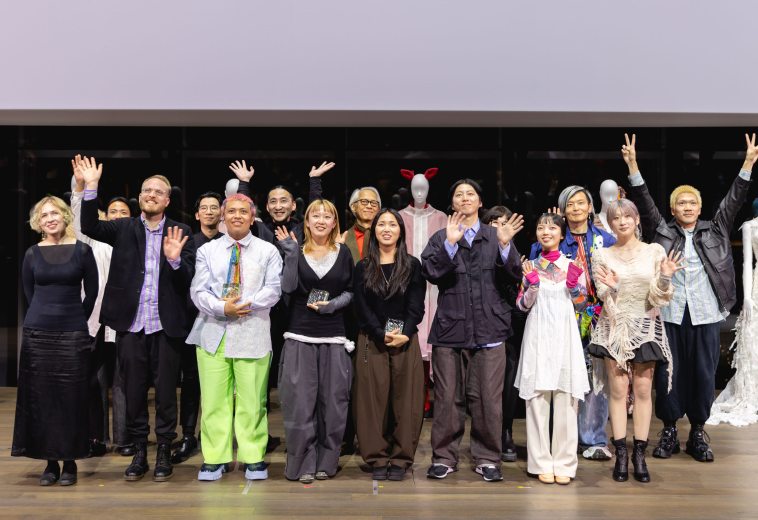
Accompanying videos that trace each finalist’s journey, we present their reflections on the six months of the program and their aspirations as designers moving forward.
These messages embody each individual’s path and resolve—please take a moment to read them.
In this article, we introduce four finalists and prize winners.
Be sure to read Part 2 as well.
Alicja Kamaj
Title: Surrender
ーーWhat stands out most to you from your experience with FFP?
Although the competition is ultimately oriented toward creating fashion, it deliberately places less emphasis on design details or aesthetic choices, instead focusing on why you want to create and what message you aim to convey. The core of the program lies in taking responsibility for creation within current circumstances, and in gaining insight into how you can consciously move forward from that position.
At the end of this journey, I deeply appreciate this approach. I feel trusted in my skills and expertise in design and creation, and valued for who I am as an artist. At the same time, the process encourages me to reflect on how to translate this way of thinking into a professional context and within the fashion industry, expanding my perspective beyond the object itself.
In most competitions, participants are judged primarily on the final product. Here, however, the emphasis lies on process and how creativity can address specific issues, how ideas can evolve, or even be completely transformed, allowing space for experimentation, uncertainty, and mistakes. This is what makes this competition truly unique.
ーーWhat changes occurred in you before and after participating in FFP?
I think I have developed a stronger sense of my identity as a designer, or perhaps more precisely, as an artist. I have gained a clearer understanding of what distinguishes me from other creators, which I find particularly valuable for moving forward and positioning myself professionally. When you have numerous opportunities to engage in discussions with other professionals and artists across the industry, especially those coming from different environments rather than a single, closed bubble, you begin to see more clearly where you belong. I would not say that this is solely the merit of the program and the competition; I believe I have been in this process for quite some time. However, the FFP incubation period and the final events reaffirmed the directions I would like to pursue in my career.
ーーPlease share your future aspirations for yourself and for society.
Recognising the value of community, I aim to build on this in my future. I am exploring new ways of creating fashion with a focus on collaboration. By joining our creative forces, we can achieve a greater impact. While developing my professional career, I hope to find opportunities to navigate this path not in isolation, but alongside others.
My attempts to evoke emotional reactions through the objects I create have an effect, so I trust my instincts. It’s a great challenge to design clothing that is experienced intimately by the wearer, fostering a personal connection, rather than simply manifesting status.
Ao Umemiya
Title: MUSUHI
ーーWhat stands out most to you from your experience with FFP?
The phrase “keep throwing balls into the darkness.” When I heard these words during a lecture, they gave me the courage to embrace the reality positively: “It’s okay to continue creating even without correct answers or an audience.” What is currently valued isn’t necessarily the only right answer. If questioning what is now taken for granted and continuing to make proposals without being defeated by others’ opinions can spark the creation of something new, then I felt I should act with courage. Through this experience, I created garments that could spark conversations when worn, and FFP marked the beginning of my throwing balls into the pitch-black darkness where nothing is visible. I hope these balls will reach as many people as possible, and I want to keep throwing them into the future.
ーーWhat changes occurred in you before and after participating in FFP?
Feeling strongly about something can hurt something else. I learned that while it’s easy to talk about social responsibility, it’s actually much more difficult to communicate it to many people through your work. Even if you have a clear message you want to convey and can put it into shape, if the balance is too good, it won’t reach many people. Fashion designers don’t just design clothes, they have to design information as well. If your feelings aren’t conveyed, the work you create through trial and error could end up as mere trash. It was difficult to find the right balance because I didn’t want my work to be superficial and I strongly wanted to connect with society. Realizing this fact was the biggest benefit I gained from FFP.
ーーPlease share your future aspirations for yourself and for society.
As I continue to confront environmental issues, I would like to not only present clothing that conveys my feelings, but also create exhibitions and projects that focus on the background behind them. I believe that environmental issues in the apparel industry, not just the fashion industry, affect everyone who wears clothes and is part of the consumption cycle. Rather than ignoring the fact that our bodies and minds are somehow caught up in the consumption cycle, I would like to continue to make proposals to society that serve as guideposts for how we should act, taking this fact into consideration.
Emily Misaki Hon
Title: Relics
ーーWhat stands out most to you from your experience with FFP?
A standout during my FFP experience was the learning period during the lectures, not only shaping my project, but also my mindset and philosophy. Through both the content and delivery, I felt a deep sense of care and intention from mentors across different disciplines, as well as from the wider FFP team. This nurturing environment consistently reinforced the power of fashion through their own works and experiences, communicating how art and personal voice can influence society and culture.
Learning from mentors who explored beyond the surface of their craft, yet shared the same passion for building a more responsible future encouraged me to think more critically about social responsibility. Their guidance pushed me to focus on the messages my work communicates, making purpose central to my creative process. Another standout was being inspired by contestants worldwide, seeing different stories and perspectives, while building a sense of community and shared growth.
ーーWhat changes occurred in you before and after participating in FFP?
There have been significant shifts in my perspective since participating in FFP. Prior to the program, my understanding of fashion felt limited by a traditional educational framework, and I struggled to find a clear direction and voice as a designer. Through the lectures and experiences within FFP, I was introduced to a broader and more holistic view of fashion, one that extends beyond creating clothing and has the potential to influence society in meaningful ways. The program bridged the gap between the facts I learned at university and the realities those facts affect, building both understanding and empathy. I gained a deeper awareness of how the fashion industry impacts the environment and people’s lives, and the weight of the decisions designers carry. FFP grounded me and provided a clear blueprint for the direction I want to pursue. After this experience, I feel more clear in my philosophy, more aware of my responsibility, and motivated to create work that genuinely connects with people and helps catalyse meaningful change.
ーーPlease share your future aspirations for yourself and for society.
In terms of my future aspirations and the kind of designer I hope to become, I want to carry forward what I’ve learned through FFP and continue developing as a designer who contributes meaningfully to society beyond simply creating clothing. I aim to use the art of fashion as a tool to open dialogue, challenge conventional perspectives, and highlight issues within the industry and the wider world. Through my work, I hope to encourage reflection, conversation, and awareness, allowing fashion to resonate with people on a deeper level. Ultimately, I want to keep challenging myself to create work that fosters connection and contributes to positive, responsible change.
Gerald Brandstätter
Title: ReBloom / Itadori
ーーWhat stands out most to you from your experience with FFP?
I am deeply grateful for the opportunity to participate in the Fashion Frontier Program. The inspiring lectures consistently encouraged me to rethink and refine my work, pushing me to grow both creatively and conceptually. One moment that stood out in particular was Yuima Nakazato’s quote, “designing is like throwing a ball into the dark,” which profoundly resonated with me and has stayed with me throughout my process.
Through FFP, I learned to trust my ideas and to continue developing them even during moments of doubt, when progress felt uncertain or impossible. The program strengthened my confidence to move forward despite challenges. Especially meaningful was the experience of being in Tokyo and exchanging ideas in person with the other finalists. That sense of shared curiosity, openness, and mutual support made the experience truly special and unforgettable.
ーーWhat changes occurred in you before and after participating in FFP?
Before participating in the Fashion Frontier Program, I often questioned whether my ideas were too experimental or niche to be pursued further. Through FFP, this uncertainty shifted into a stronger sense of purpose and commitment. The program reinforced my motivation to continue developing my concepts and to trust their relevance within a changing fashion landscape.
More importantly, it sharpened my awareness of how essential a transformation in both fashion systems and design thinking has become. Seeing how other finalists approach sustainability—not as a trend, but as a deeply embedded design strategy—was incredibly inspiring and eye-opening. It encouraged me to think more holistically about materials, processes, and responsibility.
After FFP, I feel more grounded in my values as a designer and more confident in contributing to a future of fashion that embraces experimentation, responsibility, and long-term thinking.
ーーPlease share your future aspirations for yourself and for society.
Moving forward, I want to continue developing my concept of working with invasive and problematic plants as valuable resources, an approach that was strongly reinforced through my experience with FFP. I see great future potential in rethinking these plants not as waste, but as materials that can actively contribute to more sustainable design practices. My ambition is to work at the intersection of environmental protection, biodiversity preservation, and fashion design, using my practice to question existing systems and propose regenerative alternatives. Ultimately, I hope to contribute to a fashion landscape that values ecological responsibility, experimentation, and long-term impact.
FOLLOW US
●○━━━━━━━━━━━━━━○●
Please follow FASHION FRONTIER PROGRAM on Instagram for the latest information.
▶︎▶︎FFPInstagram https://www.instagram.com/ffp.jp/