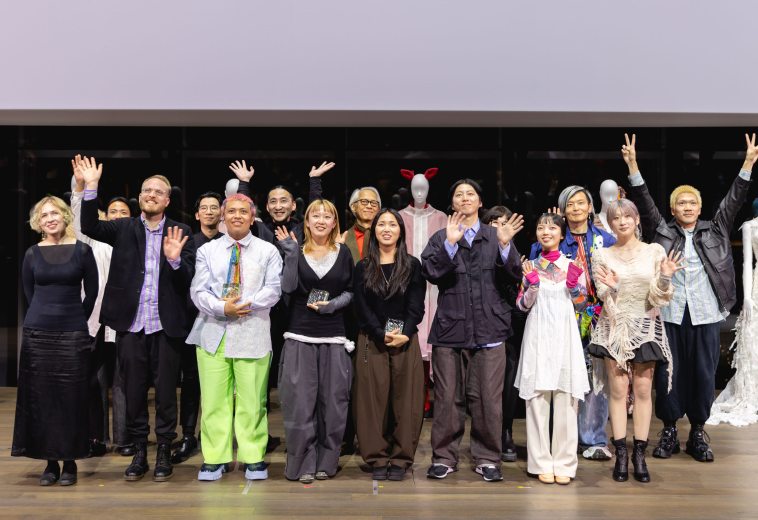
The Fashion Frontier Program (FFP) launched in 2021 with the mission to discover and nurture the next generation of fashion designers who combine social responsibility and creativity.
Yuima Nakazato, the fashion designer behind the initiative, spoke about the program’s origins and its current direction.
— What led you to establish FFP?
Around 2020 when the COVID-19 pandemic radically changed the world, awareness of sustainability grew.
And a global mood of reflecting it on our lifestyles began to take hold.
I, too, began to reconsider my approach to creation and took a deeper look at the fashion industry that I’m part of.
I began to wonder:
How should creators shift their mindset under these circumstances?
Where should they turn to for knowledge?
What standards does the world use to evaluate creativity today?
Out of this questioning came the idea of creating “a place where learning and evaluation are combined”.
Not just ordinary award, FFP is a multifaceted program that offers spaces for education and reflection,
as well as long-term support for participants’ future activities.
Our goal is to redefine what it means to be a designer.
We want to go beyond the traditional model of success—launching a brand, opening boutiques, and gaining global recognition.
By discovering and supporting a broader spectrum of creative talent,
we believe we can unlock new possibilities in the fashion industry.
— What makes FFP different from other awards?
At FFP, we evaluate creators not only based on where they are now,
but also on their “ambitions” and “potential”.
We’ve eliminated as many barriers as possible: we accept applicants regardless of age, occupation, experience, or nationality.
Another key feature of FFP is the diversity of our jury.
Our panel includes not only fashion experts but also professionals from fields like science,
architecture, and contemporary art. Fashion is essential to human life.
That is why we believe it should be discussed and judged from diverse perspectives.
It’s not uncommon for someone overlooked by other competitions to be recognized through FFP.
Our finalist program is also quite unique.
We invite experts in both social responsibility and creativity from around the world to deliver lectures.
These are followed by intense Q&A sessions where finalists—each with different perspectives and backgrounds
—engage in rich dialogue and learn from one another.
Sometimes, these moments lead to a complete transformation.
Finalists may dismantle their original values and aesthetics and create something entirely different from what they envisioned at the time of entry.
This process—of having their values broken and rebuilt—is extremely important for creators.
It can be challenging, even frightening for some, but it results in a much stronger, more resilient sense of creative identity.
We’ve seen some finalists go through truly remarkable growth during the program.
Balancing social issues and creativity can seem like a high bar,
but even just looking at past winners or reflecting on what social issues matter to creators can be a meaningful first step.
I encourage them not to hold back—just give it a try.
— How do you envision the future evolution of FFP?
We want to enhance the support we offer to help connect creators with society.
One of the areas we’re exploring is providing creative management services.
We’re also interested in facilitating deeper connections between creators and local production communities or traditional industries across Japan.
Some applicants have already started conducting fieldwork to visit production sites and factories.
We hope to support and expand these efforts through FFP.
We’re working to strengthen our international presence as well.
Since we began publishing information in English, we’ve seen more international applications.
Julia Moser from Austria, who won the runner-up prize in 2023, even began teaching a university course on FFP.
Since 2022, we’ve also showcased our finalists’ work at Ars Electronica, a leading media art festival in Austria,
and facilitated workshops and exchanges there.
We also want the general public to get to know FFP better.
Fashion is something everyone engages with in everyday life, so it’s an accessible entry point.
We’d love for people to enjoy the award as entertainment, we also hope it sparks reflection—through the winning works—on the meaning and function of clothing, and the complex social issues woven into it.
FOLLOW US
●○━━━━━━━━━━━━━━○●
Please follow FASHION FRONTIER PROGRAM on Instagram for the latest information.
▶︎▶︎FFP Instagram https://www.instagram.com/ffp.jp/
![FASHION FRONTIER PROGRAM 2026 Entry Information [Application closed]](https://ffp.jp/wp-content/uploads/2026/04/ffp2026_opencall_hp_pc_IN-758x520.jpg?crop=1)