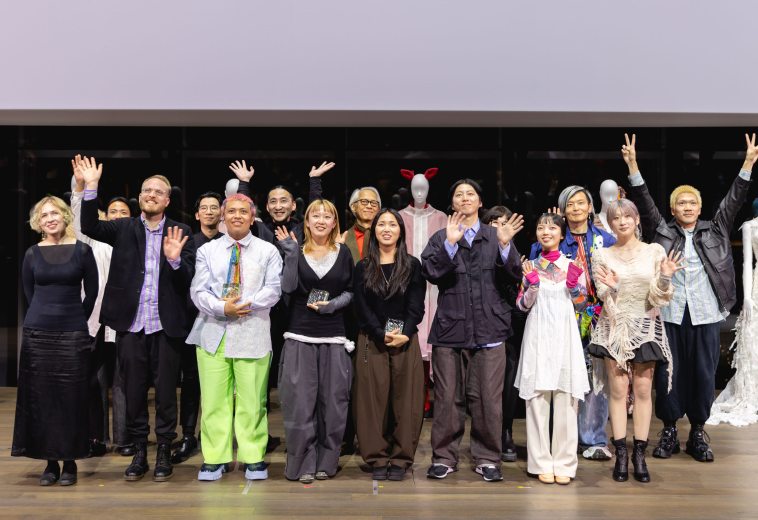
Lecture 2 was held, and we would like to introduce a part of the lecture and what the semifinalists learned/new perspectives they noticed.
Lecturer / Theme
Lecturer: Ms. Arisa Kamada (Co-founder of unisteps)
Theme: “The Concept of Social Responsibility”
Lecture Outline
In this lecture, the focus was placed on “social responsibility,” one of the pillars of FFP, highlighting the realities of clothing from production to disposal.
The lecture shed light on the large-scale waste issues in places such as Kenya, as well as the increasing supply and declining prices of clothing in Japan, making clear the challenges of environmental burden, labor issues, and lack of transparency.
At the same time, concrete approaches toward transformation were introduced, including the creation of garments cherished over time, circular production models, and ethical business practices.
It was emphasized that creators bear the responsibility to carefully consider materials and production backgrounds, to balance uniqueness with sustainability, and to design their own ways of engaging with society.
Key Points Learned
Some of the key points that were learned by the semi-finalists and last year’s winners who attended the course are listed below.
“I had previously learned about the issues in the fashion industry through literature and research, but from Ms. Kamada’s talk I was able to learn about the raw, on-the-ground realities. It made me realize once again the scale of the problems and how their severity is accelerating. Opportunities to confront such negative aspects of the fashion industry are rare, so hearing about them directly was a significant learning experience.”
“It really emphasised that, as designers, we can have a substantial influence on these issues and are able to make more informed choices that not only highlight these problems but also reimagine the lifecycle of clothes. However, I also noted that there are many nuances to this topic and no simple answer to resolve it.”
“I realized that there are ways for designers to create while considering the next stage of clothing—for example, thinking from the outset about what happens afterwards in collaboration with recycling companies.”
“Through the talk, I was able to face issues that, as a creator, I should obviously know about, but had previously closed my eyes to, thinking they didn’t directly concern me. Regarding the project ‘Seeds of Clothes’, I thought it was wonderful that it provides a place to experience and engage with the process from seed to garment. We tend to focus only on material things, but this gave me a new option: creating experiences.”
“The question of whether ‘we need to produce new clothes’ is something I constantly carry within me. Materially speaking, it might be best to stop producing new garments and simply use what already exists. However, in today’s world where clothing has become ‘more than just things,’ embodying ways of being, I reached my own conclusion that new clothes are still necessary. Based on that, this lecture gave me ideas for several approaches, such as designing clothing that is easier to dismantle and regenerate, or creating mono-material garments.”
Participants expressed strong impressions of the stark realities of the industry, such as the rapid increase in fiber production and the extremely low rate of clothing recycling.
Many also reflected on the need to rethink consumption and disposal, adopting perspectives such as viewing a garment’s lifespan through “how long it remains loved,” and showing growing interest in design approaches that assume disassembly and regeneration.
In addition, they reaffirmed their responsibility to “create dialogue through their work,” voicing determination to pursue creation that considers everything from material selection to circularity.
This session appears to have been an important step forward in exploring truly sustainable ways of making.
FOLLOW US
●○━━━━━━━━━━━━━━○●
We will continue to provide an overview of each lecture and what the semifinalists learned from it.
For the latest information, please follow us on FASHION FRONTIER PROGRAM’s Instagram.
▶︎▶︎FFP Instagram https://www.instagram.com/ffp.jp/