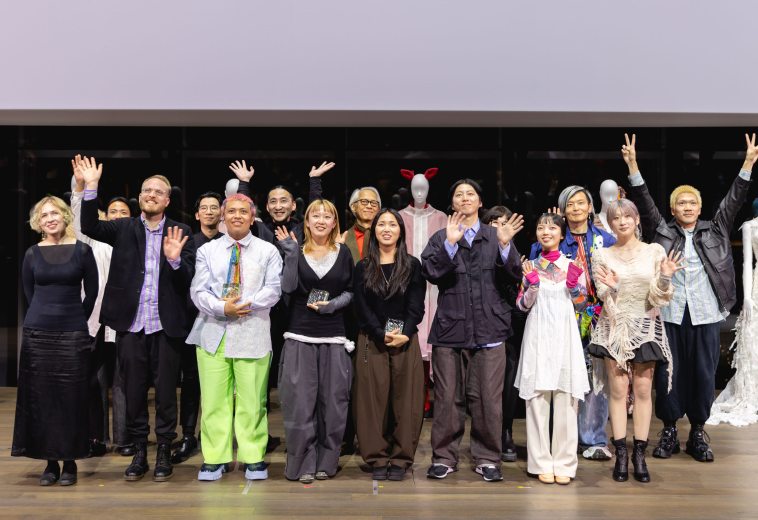
Lecture 5 was held, and we would like to introduce a part of the lecture and what the semifinalists learned/new perspectives they noticed.
Lecturer / Theme
Lecturer: Aya Nagata (Office for Mainstreaming Biodiversity, Ministry of the Environment)
Theme: ”Fashion and the Environment: The Social Renovation That Design Brings”
Profile
Joined the Ministry of Environment in 2005.
She has been in charge of industrial waste management, air pollutant emission control measures, legal reforms related to the Nagoya Protocol and Minamata Convention, policies and projects related to environmental and ESG finance, and plastic resource recycling measures.
Current position from July 2024. Responsible for promoting the transition to a nature-positive economy, among other things.
For fashion and the environment, a task force of volunteers from within the Ministry was set up in 2020, and the task force leader was appointed in July 2024 after returning from a secondment to the Kyoto City.
Lecture Outline
It was demonstrated with data that the fashion industry has a significant impact on the climate crisis, and the necessity of institutional and societal responses to realize a sustainable future was discussed. Five pillars were presented: the current state of the global environment, the responsibility of the fashion industry, pathways toward a sustainable fashion sector, the rising tide of social change, and individual practices. The lecture emphasized that by linking legal and policy frameworks with the proactive actions of creators/designers and consumers/citizens, the industry can evolve into a circular and responsible one. In addition, the activities of the Ministry of the Environment’s “Fashion and Environment Task Force” were introduced.
Key Points Learned
Some of the key points that were learned by the semi-finalists and last year’s winners who attended the course are listed below.
“One point that really stood out to me was the idea that a large amount of discarded clothing still holds the potential to be reused, something society often overlooks.”
“I was once again reminded that while there is a “resistance to reuse” in Japan, there is also the reality that many people turn to inexpensive fast fashion imitating vintage designs—and that behind this lie deep consumer psychology and cultural factors.”
“What I found particularly insightful was the realization that not only complex fiber blends but also the collection of used clothing itself can be problematic for recycling.”
“In my future creative work, I want to stay mindful of environmental impact and approaches to reuse, and focus not merely on pursuing “newness,” but on creating works that incorporate sustainability and cultural value.”
“Although my own work may at first seem far removed from practicality, I was made to realize that by re-presenting the invisible environmental burden and cultural meaning embedded within it as a “story,” my design could shake people’s awareness and imagination, and serve as a trigger for their next actions.”
In this lecture, participants were struck by concrete data on the environmental impact of a garment’s lifecycle. Figures such as CO₂ emissions and water usage made the issue feel immediate and connected to daily consumption and creative practice, leading to the realization that not only “remaking” but building systems of circulation is essential.
The lecture also highlighted Japan’s dual cultural tendencies of being “fond of the new” and valuing “mottainai,” as well as the psychological and cultural barriers to reuse. These perspectives underscored the need to address society and culture in pursuing sustainability.
The combination of numerical evidence and diverse viewpoints provided a strong impetus for participants to rethink both their creative work and consumer behavior.
FOLLOW US
●○━━━━━━━━━━━━━━○●
We will continue to provide an overview of each lecture and what the semifinalists learned from it.
For the latest information, please follow us on FASHION FRONTIER PROGRAM’s Instagram.
▶︎▶︎FFP Instagram https://www.instagram.com/ffp.jp/
![FASHION FRONTIER PROGRAM 2026 Entry Information [Application closed]](https://ffp.jp/wp-content/uploads/2026/04/ffp2026_opencall_hp_pc_IN-758x520.jpg?crop=1)