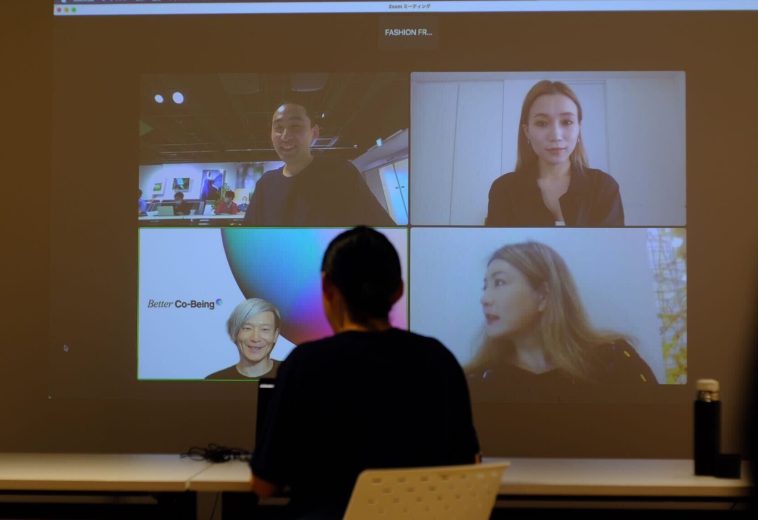
Hirofumi Kurino (Senior Advisor, United Arrows Co., Ltd.): We founded United Arrows in 1989 and I served as an executive for 20 years before stepping down about a decade ago to become a senior advisor. My main responsibilities involve overseeing creative direction and training buyers. I collaborate with the sales team to discuss the future of sales methods.
Creative direction involves envisioning the overall direction the company will take six months or a year from now, what kind of clothing we should procure, and how we should create it. In my view, one of the themes for 2023 is “Immigration and Mix Culture.” I share this with our buyers, directors, and merchandisers, breaking it down to prepare something that will ultimately reach our customers. Environmental concerns and sustainability have become unavoidable considerations in this line of work today.
The fashion industry is often said to be the second-largest environmental polluter after the energy industry. Until the 20th century, the fashion industry was essentially about producing a lot and being happy if it sold a lot. However, as a result, problems have become evident, such as overconsumption of resources, massive water consumption and environmental pollution due to dyeing fabrics, and unhealthy working conditions. Having been involved in clothing for 40 years myself, I believe that there should be no negative elements in the products we sell or that our customers purchase. We must address anything that has a negative impact on the environment during the production process and after the products are sold.
Nakazato: Everyone is familiar with United Arrows, but not many people may be aware of the breakdown from the keyword “Immigration and Mix Culture” when selecting products or the environmental consciousness behind it. I think it’s because there’s a clear philosophy behind it that United Arrows has been loved as a select shop for such a long time.
Koichi Goka (Head of Biodiversity Division, National Institute for Environmental Studies): I am an ecologist and biologist conducting research related to environmental conservation at the National Institute for Environmental Studies, a research institute under the Ministry of the Environment. While fashion may seem far removed from my field, as Mr. Kurino mentioned earlier, it is a fact that fashion, like many other industries, imposes a significant environmental burden. Whether it’s fashion, automobiles, electronics, or food, mass production processes often result in environmental alterations. Expanding agricultural land requires deforestation and substantial water usage. Transportation of finished products consumes vast amounts of energy, and dealing with waste and emissions demands additional energy, all of which contribute to environmental burdens.
In the past, when the population was smaller, there was a belief that a small amount of waste could be absorbed and naturally disposed of, as far back as the Edo period. However, with the current significant increase in population and the depletion of various resources, there are no longer places to bury what we discard. The environmental burden now far exceeds any self-cleaning processes.
The repercussions from the environment are becoming evident today, with issues such as plastic waste, pesticide pollution, invasive species, and, notably, the emergence of infectious diseases as a severe consequence. Ecosystems are resilient and tend to regulate excessive growth. Nemeses emerge to restore balance. Today, with the human population having grown so much, we are witnessing the emergence of new infectious diseases and highly toxic organisms attempting to control human numbers. Moreover, the environment itself is becoming inhospitable to humans due to global warming and environmental pollution. If we continue to ignore these issues, it’s clear that humans will face dire consequences, and the Earth will deteriorate to the point where it won’t offer a viable future for the next generation. It’s imperative that we change our ways and strive for a sustainable coexistence between a prosperous human society and nature.
Goka: OK, the rapid spread of the new coronavirus worldwide within a mere two months was largely facilitated by excessive human mobility, a consequence of excessive globalization and constant movement. Human mobility carries significant environmental costs, notably in terms of energy consumption. The phrase ‘local production for local consumption’ has been used historically to encourage people to eat locally sourced vegetables, but the need for reconsideration goes beyond this.
If a resource-poor country like Japan continues in its current state, its economy will be completely paralyzed when it is no longer able to transport goods. While discussing this, some might take extreme views, suggesting that national isolationism is the answer. However, what I want to emphasize is the importance of establishing resilience as a nation, which means maintaining a balanced sense of distance and connections while being prepared for self-sufficiency when needed. We need to avoid situations like the Ukraine conflict, where we suddenly face shortages of LNG (liquefied natural gas) and LPG (liquefied petroleum gas), and officials scramble around the world to secure resources. This situation is unsustainable. We need to have systems in place for self-generation and self-production, and it’s essential to maintain this awareness.
One issue I strongly advocate for the Ministry of the Environment is renewable energy. Japan cannot continue to rely on fossil fuels, but nuclear power is challenging given the frequent natural disasters in our country. We must steer towards renewable energy sources. However, in a mountainous country with significant topographical variations and a wide north-south climatic difference, simply erecting wind turbines or solar panels everywhere can lead to environmental degradation and raise questions about productivity. We must design renewable energy systems tailored to the environmental characteristics of each region. To achieve this, we need to shift away from the current situation where we sacrifice local environments and resources to build power plants to send electricity to major cities like Tokyo and Osaka. We need to decentralize Tokyo’s functions, enabling regions to have a self-sufficient, circular economy that encompasses energy and material production. This is the essence of the concept encapsulated in ‘local production for local consumption.’

Kurino: Over the past three years or so, I’ve received numerous requests to participate in projects related to “regional revitalization” and “local activation” in various parts of Japan, and I’ve been offering my assistance. These initiatives aim to leverage the unique characteristics of each region, such as their local technologies, traditions, and resources like hot springs, to revitalize the local economy independently, without relying on external factors. We’ve been collaborating with various regions, including Aichi, Hiroshima, Okayama, Tottori, Shimane, and Yamaguchi.
In Tokyo, there’s a platform for creating the future of the fashion industry and manufacturing called TOKYO KNIT, which consists of knit fashion manufacturers based in the city. We certify companies that possess the necessary skills and intend to pass them down to the next generation as “Excellent Companies,” as they prepare to take on the global stage. I am cooperating as a judge.
Additionally, there’s a certification system called J∞QUALITY (Japan Quality) aimed at creating demand for Japanese apparel and revitalizing the textile and manufacturing regions. The purpose is to certify products that are entirely made in Japan, encompassing “weaving and knitting,” “dyeing and finishing,” “sewing,” and “design and sales.” While Japan’s technical expertise is outstanding, without attention and support, it may fade away without successors. To attract the next generation of talent, these professions must be made more appealing. Fabric artisans, for instance, possess remarkable knowledge and a strong commitment to perfection in their work, but they often lack an understanding of what happens to their materials afterward or how the final garments are sold. That’s why we encourage them to collaborate with designers to launch factory-based brands, showcase their skills and gain recognition.
While we may not have reached the scale that qualifies as “local production for local consumption,” there is a growing enthusiasm to pursue this path. Instead of pondering how large it can become, it’s better to take action now.
Fashion used to be class-centric up until the 19th century. In the 20th century, it became product-centric, emphasizing mass production. Then, around the 1980s, when Japanese designers began to gain prominence, fashion shifted to being creative-centric. The focus became “what’s cool and well-designed.” However, there’s now a paradigm shift in the central philosophy of fashion. The idea that “being cool and well-designed isn’t enough anymore” has emerged. It’s no longer sufficient for a piece of clothing to look fantastic; it also matters how it was made. There’s a growing awareness that if thousands of people die in Bangladesh during the production process or if soil is damaged by dyes, no matter how beautiful the garment, it’s unacceptable. Today, everything is about “visibility.” It’s crucial to showcase how marvelous the production process is, as we live in an era where everything can be made visible.
Kurino: That’s right. Dr. Goka has been appearing in the media wearing black clothing and sunglasses, and this attention helps create an awareness that “thinking about things like biodiversity and invasive species is cool.” Similarly, if attention shifts toward “clothing production is cool,” it could lead to a shift in consciousness within the production regions.
Nakazato: Indeed. The fact that Dr. Goka appears in the media with impactful fashion, and many people get to see him in that light, is indeed very significant, isn’t it? Dr. Goka, what are your thoughts on your own fashion?
Goka: I wear this kind of clothing every day because it suits my taste, and I’ve ended up appearing in the media unintentionally. However, being in the media draws attention to fashion as a means of raising awareness about environmental issues. The problem with many environmental-themed programs or symposiums is that they tend to appeal only to those who are already interested. But what we really want is for people who currently have no interest or curiosity in these matters to pay attention. Attracting those without interest is the key to spreading awareness. To do that, it has to be interesting, stand out, and be visible. In my case, I’ve been unexpectedly appearing on variety shows, so I’m using that platform. When people who watch variety shows see me on programs on more serious shows, they might say, “Oh, he’s the guy from that variety show.” This increases the possibility that they’ll pay attention. In that sense, fashion is undeniably a very important tool. It’s a form of self-expression and something essential to human society. So, it needs to be unique and diverse. Instead of negating fashion as something negative due to environmental concerns, we should respect and cherish its significance. In this program, I believe it’s essential to think about how to continue to do so.
Nakazato: Dr. Goka, we can see you with the multitude of King Ghidorah and monsters in your laboratory is a distinctive part of your image, isn’t it? With the rise of Zoom meetings during the pandemic, many people saw you with these figures as your backdrop. In that context, it appeared as if these figures were accessories or part of your fashion statement.
Goka: Actually, that’s intentional. I wanted to leverage online platforms. Even if the people who don’t care about my words but just want to see the figures see my video, I think it increases the chances of having more opportunities to discuss biodiversity. So, I’ve strategically arranged them.
Nakazato: That’s interesting. It seems like there’s potential for new possibilities in fashion right there.

Kurino: Over the past decade or so, young people have started wearing yukata, casual, single-layered cotton kimono, when attending fireworks festivals and summer festivals. When I was a child, Bon Odori, the traditional Japanese dance that is generally performed at events or festivals during Obon, one of the buddhist events, holidays, was considered uncool, but now even rappers participate, and they call it “Bon Dance,” making it something cool. Certainly, there used to be a strong inclination to idolize Western culture in various aspects, not just fashion. However, I believe this trend began to wane around the mid-1980s when Japanese designers and brands like UNIQLO gained prominence. Additionally, over the past few years, the inability to travel due to COVID-19 led to more television programs showcasing domestic destinations instead of overseas reporting. As a result, the appeal of local and easily accessible places has been rediscovered. I sense that people are gradually moving away from their desire for foreign destinations.
Probably, the next step will be a reevaluation of “Made in Japan.” Japanese products are not necessarily cheap. While the short transportation distance keeps carbon footprints and shipping costs low, Japan still heavily relies on foreign raw materials, and labor costs are high. However, Japan doesn’t resort to employing children or exploiting workers in harsh conditions to produce goods. If we can add value to our products through outstanding design, the use of biodegradable materials, durability, and other aspects, they should be recognized.
The value of a product is upheld by respecting quality and proper craftsmanship, so it’s okay to raise the labor costs for those who sew or dye fabrics. For Japanese people to buy these products, we need to boost the economy, and both the upper structure (government and administration) and the lower structure (industries and retailers) need to change.
The upper structure can learn more from abroad. France, for example, made significant changes due to COVID-19. In Paris, which had severe exhaust gas issues, they reduced four-lane boulevards to two lanes, turning them into bicycle lanes. These significant changes require government and administrative actions. But the lower structure also needs to work towards prioritizing the global environment. Japan has always had the “mottainai” (waste not) mindset. Even without strict laws, people can act voluntarily. In the Edo period, Japan was one of the most advanced in terms of reusing energy, rainwater, and wealth redistribution. As long as that spirit remains, I believe Japan can survive.
Nakazato: That’s an important point. The situation where cheap clothing, despite traveling long distances, floods Japan, making domestically produced items unsellable and causing a lack of successors, is an urgent issue from both an environmental and manufacturing perspective. Thank you, Mr. Kurino and Dr. Goka, for sharing valuable insights with us today.