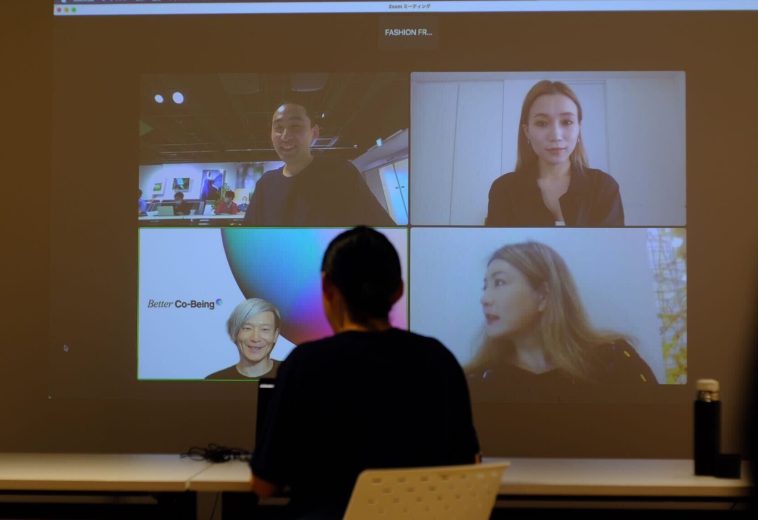
Tsuyoshi Tane (Architect / hereinafter referred to as Tane): Both architecture and clothing are essential to life. However, societal systems in Japan surrounding both fields have seen little change from the past. People often see disposal after use as normal and not particularly problematic, don’t they? Even with increased environmental awareness, behaviors haven’t shifted yet.
Nakazato: Mr. Tane, you reside in Paris. In Japan, buildings are mainly wooden, which could present challenges for material recycling. In contrast, Europe has many stone buildings that continue to serve their purpose for centuries while being renovated.
Tane: Wood, too, can endure for a considerable time. I believe you can see my residence via Zoom. It’s a 150-year-old apartment in the 20th arrondissement of Paris. It’s the top floor, and the ceiling is wooden. Despite being made of wood, it has no problems. Horyuji Temple, a wooden structure, has been in use for 1300 years, undergoing occasional repairs. As wood is a pliable material, wooden buildings can be continuously used with proper maintenance. Despite this, Japanese houses tend to be rebuilt every 30 years, largely due to the impact of the modern industrial system. Taking advantage of population growth, the Japanese government promoted housing construction as a primary economic driver, believing that constant construction and demolition would stimulate economic growth.
Nakazato: So, houses are destroyed to sustain the economy. It seems environmentally friendlier to extend the life of existing structures.
Tane: My biggest concern is Japan’s ‘service life’ system. The National Tax Agency dictates that the fiscal value—the value calculated in monetary terms—of concrete buildings and wooden houses decreases to zero after 47 and 22 years, respectively. I believe objects serve roles, and this ‘service life’ system devalues them before they fulfill these roles. Generally, the passage of time enhances an item’s intrinsic value—its value derived from its inherent worth—or at least maintains it, which is a common understanding of an object’s value from a property perspective. But in Japan, despite architecture being a cultural facet, it’s assessed purely based on fiscal value. Once this fiscal value hits zero, the building, while the land retains value, is considered worthless, leading to demolition and land sale. Then, a new house is built, stimulating economic activity. That’s why the National Tax Agency maintains this approach, but without a change in this mentality, a town’s intrinsic wealth won’t increase. Conversely, in France, both land and architecture are appraised in terms of their intrinsic value. Consequently, the value of a city keeps appreciating inherently.
Nakazato: That’s incredibly thought-provoking. In Japan, the National Tax Agency determines the fiscal value of buildings, which decreases to ‘zero yen’ over time. However, intrinsic and fiscal values aren’t necessarily interconnected. If a building is sturdily constructed and well-maintained, its value should persist or even increase. While it’s understandable that a building with a fiscal value deemed to be zero might be earmarked for demolition, it would be better if we think about the intrinsic value.
Eugene Kangawa (Contemporary Artist / hereinafter referred to as Kangawa): As a premise, contemporary art is probably the most unrestricted domain among all industries, where diverse ideas coexist. I think this is vital in and of itself, so the ideas I’ll share today are strictly my personal views.
One tremendously important element when considering the value of an object is its uniqueness—whether it’s something that exists only one. Photographs and videos require a slightly different approach, but with traditional media such as paintings and sculptures, they are complex in themselves and are considered to have a reasonable degree of preservation.
Another critical element in considering value is the rarity of the idea, concept, or invention. I believe there is value in things that no one has ever executed before, or things never seen in the same context. It takes determination, confidence, and belief to present a work, knowing that there’s a risk of not being understood. I think, museums and collectors that sense these elements of value in a piece will then assign value to it, purchase it, aiming to preserve it as long as possible, for decades or even further into the future.
Despite the enormous amounts of money involved, art does not have a direct or vast system. Even if such a system could be established, it wouldn’t last long. Therefore, systems for assigning value tend to be local and subtle. Nevertheless, I believe that in broad terms, it’s this type of valuation that sustains the economy of art.
Nakazato: In the case of clothing, the final price is often determined by adding the production cost and added value. The idea that the rarity of a concept increases its value in art is intriguing. You mean, even if the production cost is low, such as using everyday paper, if the concept is rare, it can be worth preserving permanently, correct?
Kangawa: Yes, that’s correct. Of course, it’s challenging to assign value merely by considering a concept, so there’s a need to manifest it into something tangible, like a painting or something similar. And that ‘object’ needs to be able to be preserved. For instance, with paintings, there’s a culmination of hundreds of years of restoration techniques, so even if the painting may transform at a molecular level, its value can continuously be preserved. In other words, what can be valued in art is the concept and the ‘object’ that embodies it while having a certain degree of preservation.

Tane: In the fashion industry, the world of haute couture designers picks up on the prevailing trends of the times, reflecting them in their creations, and disseminating that information through the media. There’s a difference from the clothes people wear daily. In the case of haute couture, I believe we don’t feel the ‘oldness’ as long as there’s a shared perception in society, but we start to feel it when that perception changes.
Architecture is the same in that regard. For instance, Dutch architecture became a global trend from the late ’90s through the 2000s. It wasn’t just about having a Dutch look. It was about a new approach to architecture, achieving freedom by structuring abstract diagrams from the design stage, organizing the information to be conveyed into charts and illustrations. However, that trend of Dutch architecture has now faded, with very few still practicing it. In other words, the ‘expiration date’ for an idea was only about 15 years. Currently, Japanese architecture is influential, but whether an actual Japanese architecture in a city or town will become outdated over time or blend in is an entirely different issue.
“The newness and oldness felt from the creation” and “the powerful charm of creations that do not fade over time and do not become obsolete” are two different things. Earlier, Mr. Kangawa mentioned the restoration of paintings. Medieval paintings in churches, for example, possess a powerful appeal to the spirit, despite their technical and stylistic oldness. There’s a distinction, isn’t there, between what our brains perceive as old or new information and what appeals to our bodies? When we look at things through the lens of newness and oldness, we might misconstrue our understanding of them. I believe that excellent artists, who value their unique perspectives, ways of thinking, and use of unique language, do not look at things through this axis of newness and oldness. Personally, I try not to do so either.
Nakazato: The distinction you’ve drawn between the oldness and newness felt by the brain, and the enduring strength, is fascinating to hear. Compared to architecture, fashion operates on a shorter timeline from conception to implementation in the world. That might lend a certain sense of speed to fashion. How about in contemporary art? Mr.Kangawa, how do you perceive the oldness and newness?
Kangawa: As a premise, in the world of contemporary art, there is not a single measure of value. If someone assumes that old things are bad and new things are good, choosing one and denying the other, I think they totally misunderstand contemporary art. Of course, in contemporary art, there are also art fairs and blockbusters, and people get excited according to the season. You might see something and think, “I’ve been seeing this a lot recently,” but opinions about it also vary. Sometimes ephemeral things are considered good, and sometimes eternity is valued.
A work that was once considered ephemeral can draw attention again, creating new trends. That’s one of the interesting things about contemporary art. For example, there is an artist named Barbara Kruger, who was in the spotlight in the US from the 70s to the 80s. She is famous for her works where she places a red square over an image, and puts a message in white letters on top of it. For instance, she creates works that challenge consumer society by modifying Descartes’s “I think, therefore I am,” into “I shop therefore I am,” and putting it on a photograph of a hand. The logo of Supreme, a fashion brand, imitated her work and it caused a debate. In recent years, Barbara Kruger has been in the spotlight again. What was in art in the 70s has been fully popularized, and with social changes, it has gained a new context and is seen again on the street and Instagram. This wasn’t calculated by Kruger herself. I think it’s impossible to definitively label something as oldness or newness.
Kangawa: Since around 2018, I have limited my internet use to 5 minutes a day. As a digital native generation, I like the internet, but I wanted to reduce my passive information intake. I use the restriction mode on my iPhone, which allows me to see messages and weather forecasts, but I cannot view Safari, Google searches, news sites, or social networks at all. I thought it would be a problem at first, but the important information still comes in. 30 or 40 years ago, people were able to produce wonderful works without the massive influx of information we have now, so there’s no reason we can’t do. I would recommend this to everyone.
As a result, I feel like my sense for creating works has been honed. Nowadays, whether it’s products, fashion, or architecture, extremely well-thought-out things come out as a flash in the pan and get consumed. Furthermore, the presentation of these things can sometimes be better than the reality. Consuming too much of such information is not a good thing, and I believe that original things can be made even without seeing such things.
Nakazato: It’s like “changing the way you feel about the times,” or “changing your sensor,” isn’t it? It’s a unique and interesting approach. Mr.Tane, are you doing anything similar?
Tane: It may not be a good thing as a working adult, but I myself don’t do much information intake such as reading newspapers or watching TV news. Internet searches are handy for research, so I use them sometimes, but I prefer to get information through people. I don’t want to swallow the information that media puts a spotlight on unilaterally. The information passed on from people I know is more trustworthy for me.
The computer and television have screens that emit light, so the stimulus is strong. If you sleep about 7 hours a day and look at a screen for about 5 hours, your life would be half spent sleeping or looking at a screen. That’s something I physiologically dislike. Also, I retain sentences when I read them in books, but for some reason, sentences I see in blogs or online news don’t stick in my head. I have a sense of discomfort towards the digital.
Nakazato: If oldness and newness are things you feel in your head in relation to information, then by simply changing the way you take in information, I feel that we might be able to extend the life of clothes without even having to increase the strength of the seams.
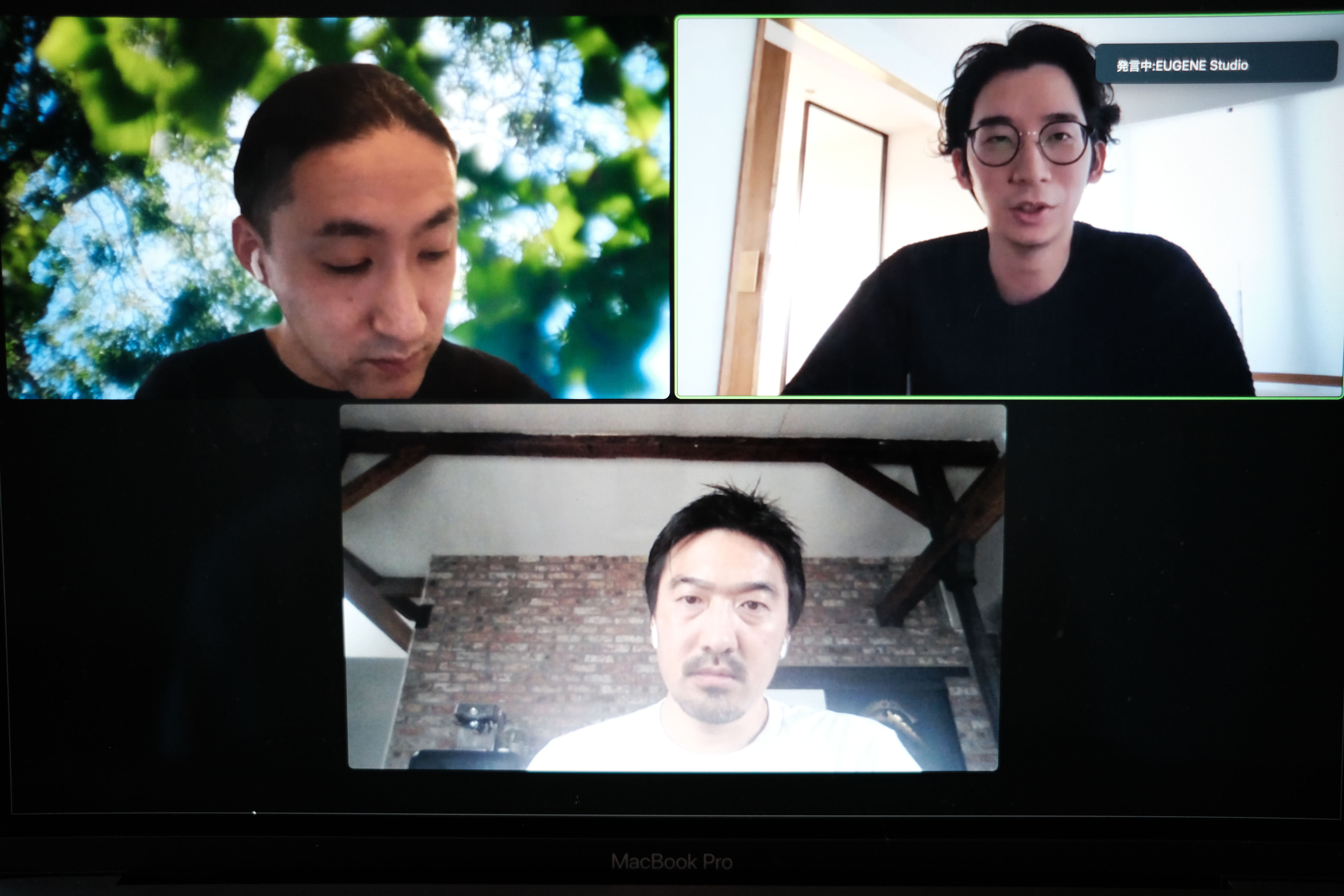
Kangawa: Thank you for mentioning it. That’s a piece from 2019. In a solo exhibition at the museum in 2021, I developed that “Shikkoku-Noh” into a sculpture work titled “Imagine #1 Man”. I myself made a human sculpture in complete darkness, and had each viewer, by appointment, enter the darkness and appreciate the sculpture by touching it. It’s a work that no one has seen, and will never be seen. I gave it the title “像を想う” (A wordplay from the word that means “想像=imagination” in Japanese. The meaning is “imagining that figure”).
” Painting is already passé ” has been said for more than 50 years. I think it’s the same with fashion, there is always a limit to the visual works. But I wondered if I couldn’t create a work that extends and reverses the context there. “Shikkoku-Noh” and “Imagine #1 Man” have aspects of resistance to lookism and discrimination based on appearance, which start from visible images, or to monumental things. Being aware of such a context might provide a hint when thinking about fashion.
The work “Imagine #1 Man” has no photographs or sketches left, so the only information available is as impressions of those who experienced it. This experience is completely different depending on the person, with some saying they see “a parent or child they lost a long time ago”, while others remember “someone from a movie they saw yesterday”. I feel that the work is positioned outside of what can be spoken of as current “information”.
Nakazato: With that concept, we might be able to move away from oldness or obsolete.
Tane: I felt that in “Imagine #1 Man”, people understand by touching the sculpture and linking it to their personal memories. In order not to be consumed by the times, in my case, I place importance on ‘memory’. Architecture has a role to play as the backdrop of a place, and it is important to have not only individual memories, but also collective ones that remain in the memories of many people across generations. Among all information, I think ‘memory’ is the strongest.
Tane: I think it’s a matter of what we perceive as a problem. Too much information can lead to anxiety. That anxiety affects emotions in a place different from reality, different from life. If we incorporate environmental considerations into the economy that circulates money, wouldn’t it become the same as the pressure to run an economy that demolishes houses in 30-year cycles? The circulation of the economy is important, but I can’t imagine a prosperous future if we discard or destroy things for that purpose, and even if we recycle them and reuse them.
Nakazato; Indeed, if we simply settle for a mechanical narrative of reusing materials once more, after the systems of recycling and resource circulation are established, it seems like the same things would end up being repeated, resulting in nothing more than an extension of mass consumption and mass production. I thought ‘memory’ might be a good keyword to shift away from that axis.
Tane: When we talk about ‘memory’, it tends to conjure images of the past, but I personally believe it serves as a driving force to imagine the future. In terms of clothing,It’s something that touches your life, accompanies you on important encounters, and accompanies you on your journey. Clothes can indeed become a crucial element in crafting your own future.
Nakazato: Yes, that’s right. I received a lot of great insights for thinking about fashion today. Thank you very much for today, Mr. Tane and Mr. Kangawa.