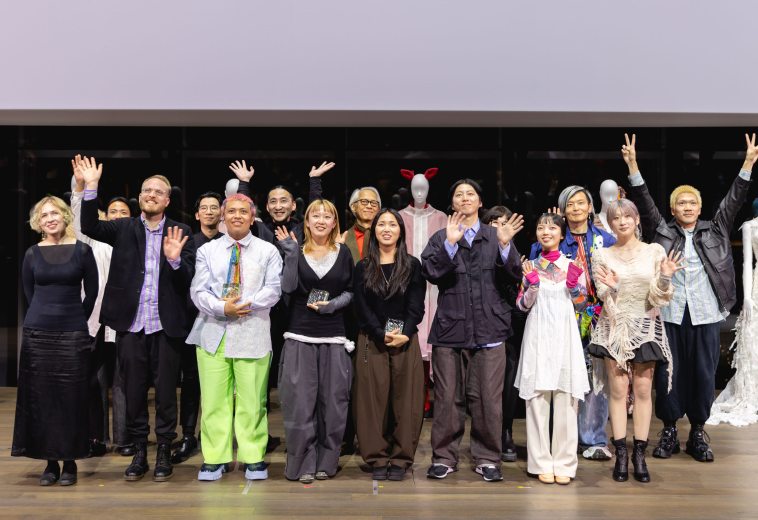
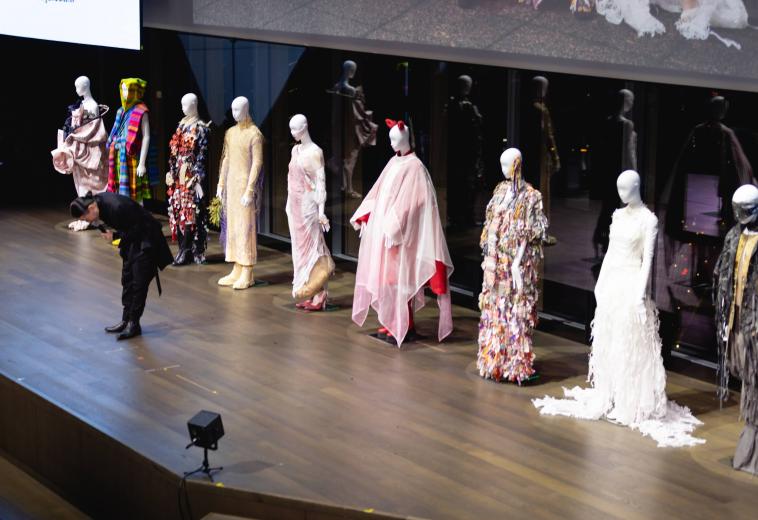
Along with portraits of each finalist, please take a look at the following information: “What has changed in your mind through the lectures so far, what you have decided to incorporate into your work” and “your enthusiasm for the final work”.
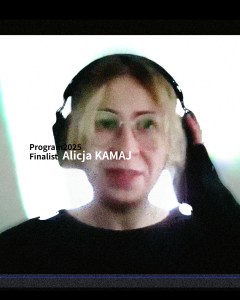
Alicja Kamaj (Poland)
Through the lectures, I experienced multiple emotions, starting with excitement in the beginning, moving through doubts and anxiety along the way, and finally ending up somewhere in between. Still, it might be a bit strange to call it “a sweet spot.” I think I’ve reached a place where I understand what I can control and do my best to use it to the fullest.
The most valuable lesson I took from the lectures was realizing that what I do alone might not be enough—and what you do might not be enough either—but together, with more people like us, things can change in unexpected ways. So let’s keep going.
I’m really excited about releasing the final project and having more opportunities to exchange experiences with other finalists, especially since our backgrounds differ so much. I know there are challenges in what I plan to do, and that makes me both curious and motivated.
However, I am a designer and the “founder” of the idea I pursue, a project in its form, material, and story, always reveals its own truth to me through the process. That’s the strange and powerful part of this work.

Ao Umemiya (Japan)
Through the FFP, my perspective has changed significantly by confronting the realities of the apparel industry head-on. Among the many lectures, the phrase “to keep throwing a ball into the darkness even if no one is there to catch it” has stayed with me most strongly. As a designer, I want to continue engaging society with my ideas and making even a small impact through my work.
As a first step, I have shared my activities directly with those close to me, collecting unused or nearly discarded kimonos from their homes and transforming them into new textiles and artworks. For me, completing the final piece is not the ultimate goal. Rather, my aim is to use the work as a medium to share ideas, spark dialogue, and create new values. With the hope that wearing “MUSUHI” becomes part of that first step, I will do my utmost to approach the final judging without regret.

Emily Misaki Hon (Australia)
Through the lectures and conversations with mentors and peers, I feel I now understand fashion and the industry more holistically with its issues, its potential for positive impact, and the role we have as designers within it. Prior to this, my knowledge felt quite surface-level. Learning about the environmental and social impacts of fashion, especially the way clothing is discarded without care for people or the environment, was eye-opening and at times overwhelming. These insights made me realise that designers do have influence, creating work that challenges systems and opens up dialogue. A key takeaway was the power of storytelling and its ability to connect with people and encourage reflection. I want to carry this into my work by creating pieces that explore beauty not as something aspirational, but as something revealed, inviting people to slow down and engage more consciously. For my final project, I’m excited to focus on upcycling and reimagining the lifecycle of garments. I feel more intentional and motivated to make work that resonates emotionally and encourages reflection on how we consume, wear, and value clothing.

Gerald Brandstätter (Austria)
The program encouraged me to adopt a holistic view and to become more aware of the connections between materials, processes, and societal issues. For me, design now means not only finding solutions to problems, but also understanding the relationships between things more deeply and opening up new possibilities for change.
For my work, this means I want to deepen my engagement with invasive plants. I have learned to see these unused resources not just as raw materials, but as carriers of cultural and ecological narratives. I was particularly inspired by Yuima Nakazato’s quote: “Design is like throwing a ball into the dark.” It encourages me to think more openly in unknown directions. The lectures also showed me how closely regenerative strategies, biodiversity, and aesthetic approaches are connected—and how important it is to consider them together.
Extracting materials from invasive alien plants and developing textile biopolymers from them is, for me, a way to open up new perspectives on sustainable fashion. I want to show that sustainability is not about restriction, but about a different attitude toward resources—shaped by respect, curiosity, and creativity. Beyond the technical concept, clothing should also be beautiful, joyful, and meaningful for society.

Hideki Morimoto (Japan)
The biggest change I experienced through FFP was deepening the depth of my design after receiving advice from Mr. Nakazato.
When I design, I constantly ask myself “why?”, and just when I thought I had reached the deepest answer, he asked me “why?” once more. Along with his guidance on how to approach such questions, I clearly remember the excitement I felt when I realized there was still a deeper layer to explore.
Another major shift was that, through the lectures, my own position—wanting to “carry traditional industries into the future”—and the issues I truly want to face became much clearer.
Within FFP, I want to create a work that offers an opportunity to confront the problems of consumption.
This comes from my feeling that in today’s life, surrounded by mass-produced products, it has become difficult to cultivate the sensitivity to recognize beauty as beauty. I believe that by engaging with traditional techniques nurtured through history and local culture, we can rekindle the rich sensibility that Japanese people have cultivated over generations.

Hikari Hayashi (Japan)
I have increasingly found myself questioning whether creating something also means producing waste at the same time. In one of the lectures, the film “DUST TO DUST” showed mountains of discarded clothing—an image that was not only shocking but also appeared fleetingly beautiful, leaving a strong impression on me.
I believe that each of us has a role to play, and for me, that role is “to shape ideas and communicate them.”
Sustainability is often discussed in terms of the environment or social systems, but I believe it also includes “human warmth and emotions.” Just as we carefully preserve children’s clothing filled with memories, respecting the connections between people, and between people and objects, is also a form of sustainability. With this perspective in mind, I want to use the thoughts born from everyday life as a guide for creating my final work.

Kazusa Horikawa (Japan)
Through the lectures at FFP, I was exposed to diverse practices and ways of thinking, which broadened my perspective beyond my initial focus on “researching materials that return to nature” through working with washi paper.
I initially struggled with doubts, wondering if creating garments designed to break down might be irresponsible. However, through lectures and dialogues, I began to see that breaking down is not simply about consumption or loss—it can become an opportunity for people to confront their own senses and memories. I want to create works that embody this idea.
Currently, I am experimenting with Echizen washi, exploring ways to control how it breaks apart. By incorporating the process of tearing and the textures of its cross-sections into the work, I aim to present clothing not as a “finished product” but as something that allows people to experience transformation.
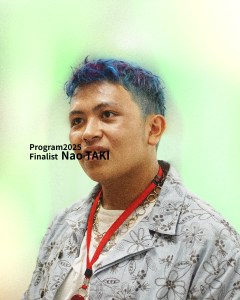
Nao Taki (Japan)
Through the lectures, I was given the opportunity to reflect on environmental impact—something I had not been very conscious of before. I realized that for designers today, it is essential not only to think about “creating” a piece of work, but also to imagine what happens to it “after it is used” and “after it is discarded.”
Based on this learning, for my final project I am creating knitted fabric using yarn that had been destined for disposal at a factory, giving it new life. Exploring how creativity can emerge within the limits of available resources has had a significant influence on my own approach to making.
At the same time, learning about the issues within the fashion industry also gave me a chance to deeply reconsider what kind of creator I want to become in the future. With the aim of producing work that is sustainable and can brighten someone’s everyday life, I will give my all until the very end.
How will each of the finalists express the ideas they have thought through, broken down and reworked their own standards over and over again?
A “work of art” is not only about making clothes, but also about how the wearer feels and how the clothes are presented, including the model and posing.
All of these elements are incorporated into the shoot, so please look forward to it.
FOLLOW US
●○━━━━━━━━━━━━━━○●
We will continue to provide the progress of the finalists till the final selection.
For the latest information, please follow us on FASHION FRONTIER PROGRAM’s Instagram!
▶︎▶︎FFP Instagram https://www.instagram.com/ffp.jp/