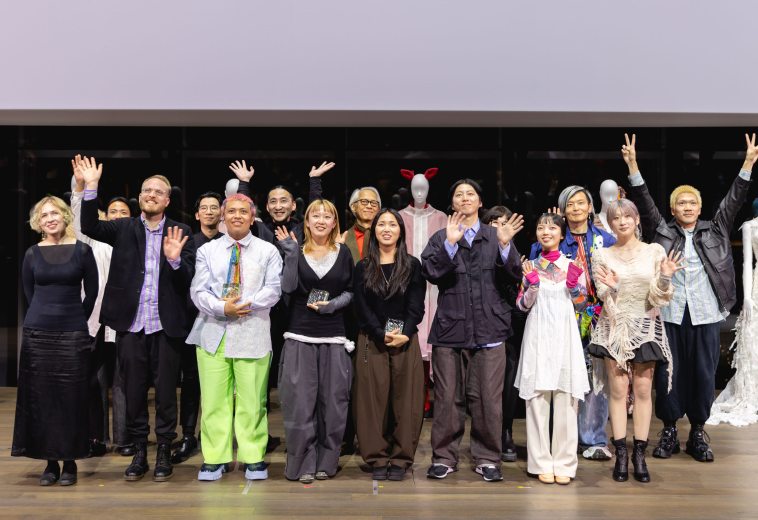
Lecture 8 was held, and we would like to introduce a part of the lecture and what the semifinalists learned/new perspectives they noticed.
Lecturer / Theme
Lecturer: Kotaro Watanabe (Context Designer at Takram/ Visiting Professor at Tohoku University of Art and Design)
Theme: “Throwing a ball into the dark — Parallels between Context Design and Haute Couture”
Profile
As a context designer, Kotaro aims to turn users into creators, and consumers into artists, through involving people in design. His activities range from vision setting for organizations, service design to art projects. Past works include FLORIOGRAPHY, a collaborative gift-giving project of flower and letter-writing with ISSEY MIYAKE, branding of Morioka Shoten, a bookstore that sells a single book at a time, and NIKKEI, the owner of the Financial Times, among others. Graduated from Keio University SFC, Kotaro is also an author of several books, and a radio personality, expanding the boundaries between design, culture and art. He practices Japanese tea ceremony, and is professor of Santokuan, Japan Association of the Tea Ceremony. Kotaro holds worldwide lectures and workshops, whilst running projects internationally. He served as juror of German iF Design Awards, guest professor at Keio University SFC between 2019 and 2024, and at Tohoku University of Art and Design from 2024 onward.
Lecture Outline
Building on past conversations with Yuima Nakazato, the lecture explored the overlap between context design and haute couture. From there, the discussion broadened to consider the distinctions between haute couture and prêt-à-porter, and what it truly means to imagine the unknown.
Examples from Watanabe’s own practice were also introduced, such as Morioka Shoten, a bookstore that features only a single title, and an hourglass whose meaning expands through the personal stories of its users. These projects illustrated the possibility of shifting away from designers unilaterally assigning meaning, toward a model where users actively weave context and participate in creation.
Finally, the lecture emphasized that fashion and design are practices rooted in both joy and responsibility—the joy of “touching the lives of others,” and the responsibility that such engagement entails.
Key Points Learned
Some of the key points that were learned by the semi-finalists and last year’s winners who attended the course are listed below.
“Tradition = where it can deviate. Breaking down and deeply exploring the old character (傳燈 – Dentou), I was struck by the idea that tradition is not something classical and fixed, but something that is constantly evolving.”
“I was intrigued by his framing of Yuima Nakazato’s approach as “throwing with full force into darkness,” where recognition may come only much later – or not at all. This idea of delay, of allowing meaning and joy to surface in time, offered a strong counterpoint to the accelerated pace of mass fashion.”
“I realized that ‘new’ does not mean creating everything from scratch, but rather seeing what already exists from a different perspective. Tradition is not something to be fixed in order to preserve it, but more like adding oil to a flame so it can continue to live on.”
“This lecture gave me a deeper insight and brought up some new thought points about a designer’s purpose. One of the main takeaways for me was the idea of “designers as catalysts” that even through your own creations and designs, the audience or individuals are still able to form their own stories by resonating and connecting with what’s been made.”
“I resonated with the perspective that ‘when you create something, the recipient’s story expands from it.’ In my future work, I want to consciously create pieces that stimulate the creativity of the wearer, while considering how stories are born and spread through the clothes once they are worn.”
Many participants shared that what impressed them most in Watanabe’s lecture was the idea of “designing the void,”exemplified by the concept of a “bookstore with only one book,” as well as his remark that “tradition is not something to be fixed, but something that continuously evolves.”
They reflected on the realization that “new” does not mean starting from zero, but rather seeing existing things from a fresh perspective, and that designers can act as catalysts who expand people’s stories through their work.
Others resonated with his exploration of the contrast between prêt-à-porter and haute couture, and with the importance of engaging users not just as recipients but also as creators.
Overall, the lecture offered a valuable opportunity to rethink the relationship between tradition and innovation, and to rediscover the potential of design as a force that connects people and society.
FOLLOW US
●○━━━━━━━━━━━━━━○●
We will continue to provide an overview of each lecture and what the semifinalists learned from it.
For the latest information, please follow us on FASHION FRONTIER PROGRAM’s Instagram.
▶︎▶︎FFP Instagram https://www.instagram.com/ffp.jp/